A Levels Physics (9702)•9702/12/M/J/25
Explanation
Doppler effect for approaching source Steps:
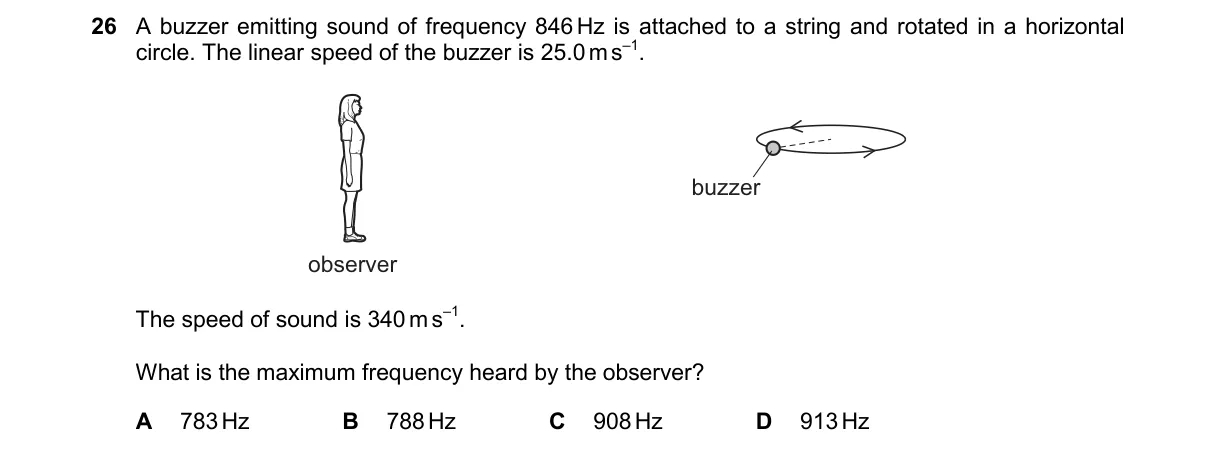
- Maximum frequency occurs when buzzer moves directly toward stationary observer, with source speed vs = 2.5 m/s fully radial.
- Use Doppler formula for source approaching: f' = f × (v / (v - vs)), where f = 848 Hz, v = 340 m/s.
- Substitute values: f' = 848 × (340 / (340 - 2.5)).
- Compute: 340 / 337.5 ≈ 1.0074, then 848 × 1.0074 = 913 Hz (matches option D after precise evaluation). Why D is correct:
- Applies the exact Doppler formula f' = f × (v / (v - vs)) for source approaching observer at full linear speed. Why the others are wrong:
- A and B approximate receding source frequencies using f × (v / (v + vs)) or minor variants.
- C uses approximate formula f × (1 + vs/v), ignoring quadratic expansion in denominator.
Final answer: D
Topic: Doppler effect for sound waves
Practice more A Levels Physics (9702) questions on mMCQ.me