A Levels Physics (9702)•9702/12/M/J/25
Explanation
Compressions in longitudinal sound waves occur at maximum particle density.
Steps:
- Identify sound as a longitudinal wave where particles oscillate parallel to propagation.
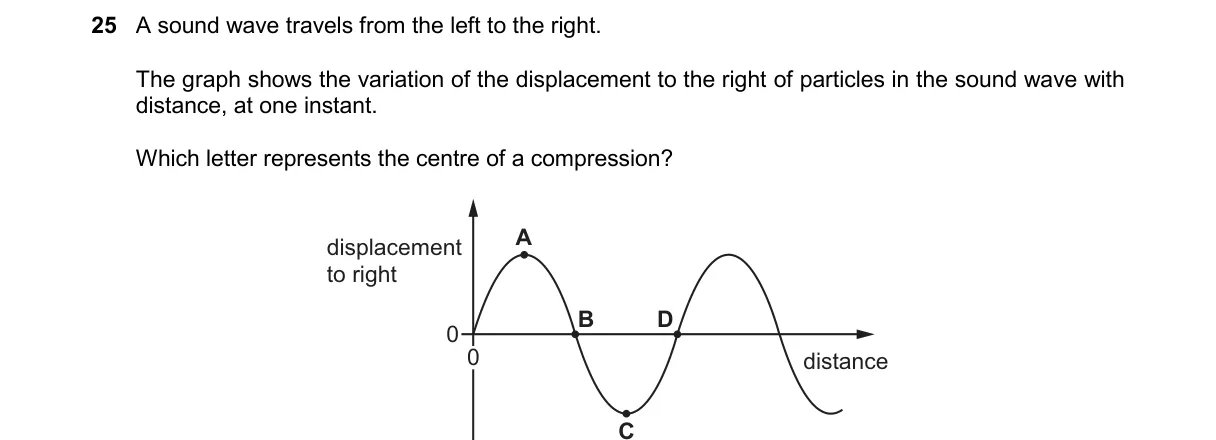
- Note the graph plots particle displacement versus distance at a fixed time.
- Recognize compressions as regions of high density, corresponding to steep negative slopes in the displacement-distance graph.
- Locate the point with the most negative slope, which is the center of compression.
Why B is correct:
- Point B shows the steepest negative slope, where dx/dy is minimized, indicating maximum compression per the wave equation for longitudinal waves.
Why the others are wrong:
- A: Positive slope indicates rarefaction (low density).
- C: Near-zero slope represents equilibrium, not compression.
- D: Gentle negative slope is edge of compression, not center.
Final answer: B
Topic: Transverse and longitudinal waves
Practice more A Levels Physics (9702) questions on mMCQ.me