A Levels Physics (9702)•9702/12/M/J/25
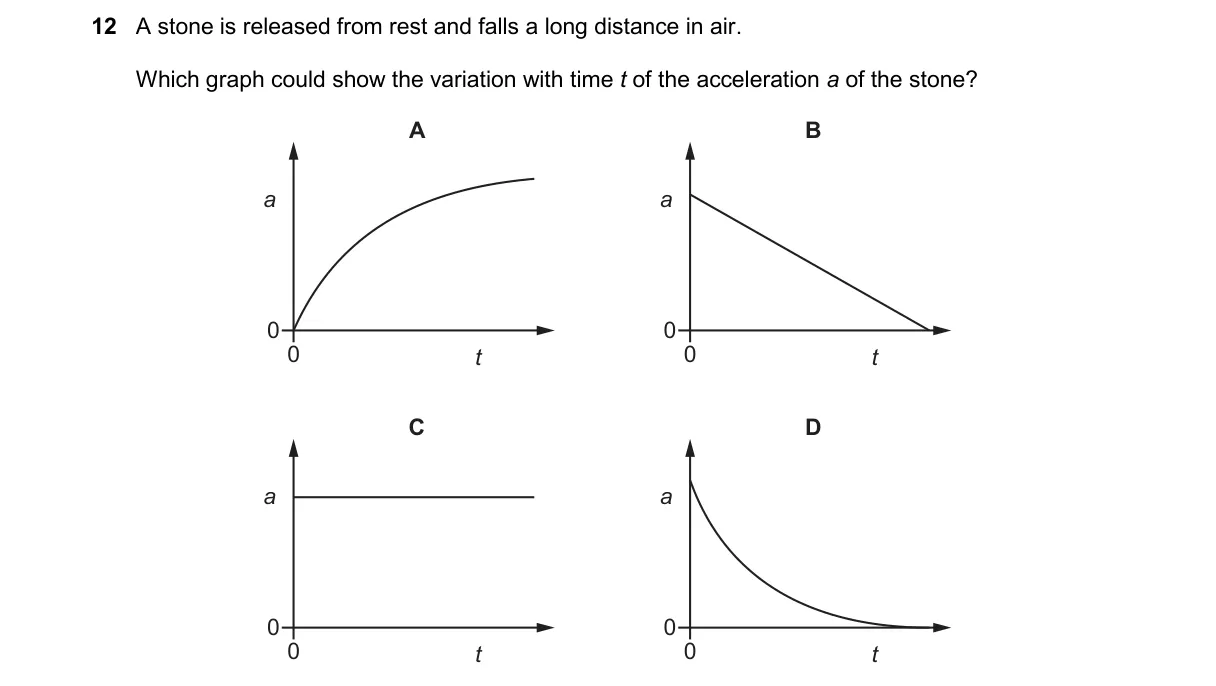
Explanation
Air resistance reduces falling acceleration over time
Steps:
- Gravity provides constant downward force mg, so initial acceleration is g when released from rest.
- Air resistance opposes motion and increases with velocity squared, starting from zero.
- Net force is mg - drag, so acceleration a = g - (drag/m) decreases as speed builds.
- For long fall, a approaches zero as terminal velocity is reached, where drag equals mg.
Why D is correct:
- D shows a decreasing from g to near zero, matching Newton's second law for net force declining due to rising drag.
Why the others are wrong:
- A: Constant a implies no air resistance, violating real-world drag effects.
- B: Increasing a contradicts drag reducing net force as velocity grows.
- C: Abrupt change ignores gradual drag buildup with continuous velocity increase.
Final answer: D
Topic: Non-uniform motion
Practice more A Levels Physics (9702) questions on mMCQ.me