A Levels Physics (9702)•9702/11/M/J/25
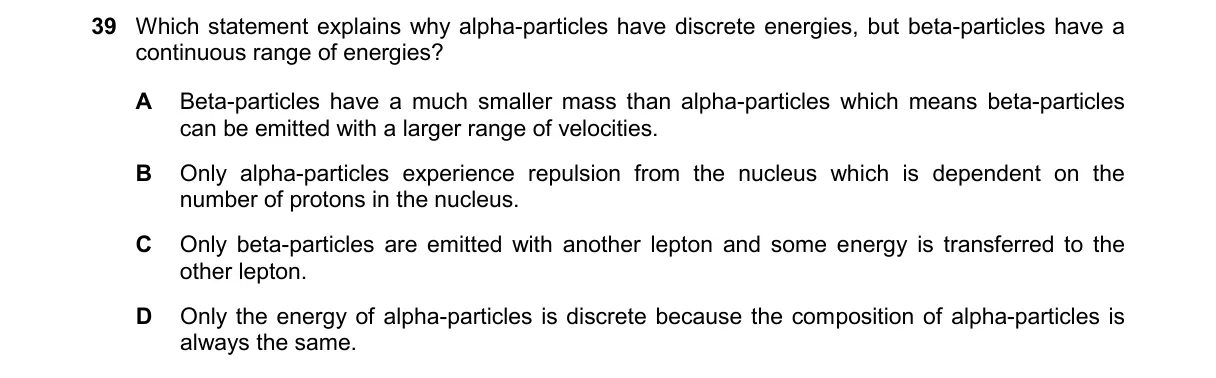
Explanation
Beta decay involves three particles sharing energy continuously
Steps:
- Alpha decay emits a helium nucleus from the parent nucleus, a two-body process where total energy is fixed and fully transferred to the alpha particle.
- Beta decay involves emission of an electron, antineutrino, and the daughter nucleus, a three-body process.
- In three-body decay, the energy is shared among the electron and antineutrino in varying proportions.
- This sharing results in beta particles having a continuous energy spectrum from near zero to a maximum value, unlike the discrete alpha energies.
Why C is correct:
- Beta decay follows the weak interaction, producing an electron and antineutrino (leptons); the Q-value energy is partitioned between them per conservation laws, yielding a range of electron energies.
Why the others are wrong:
- A: Mass affects penetration but not the discrete vs. continuous energy distribution, which stems from decay particle count.
- B: Coulomb repulsion influences alpha tunneling probability, not energy discreteness.
- D: Alpha composition is fixed, but discreteness arises from two-body kinematics, not composition alone.
Final answer: C
Topic: Radioactive decay
Practice more A Levels Physics (9702) questions on mMCQ.me