A Levels Physics (9702)•9702/11/M/J/25
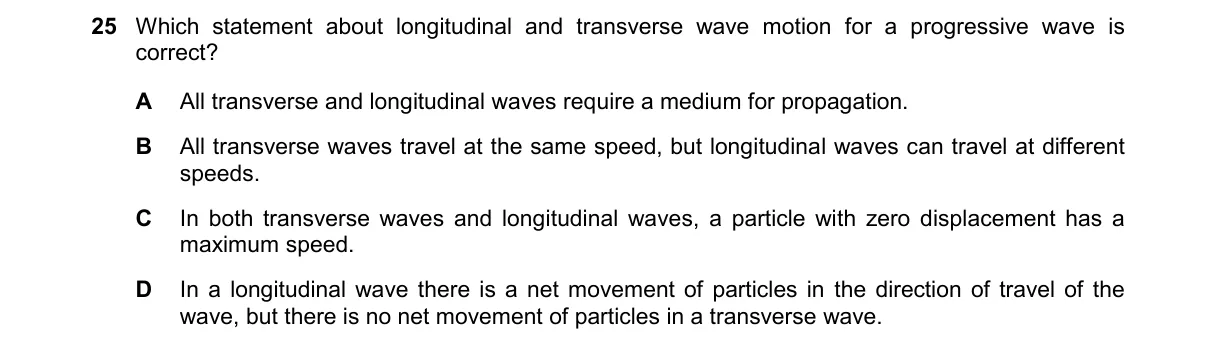
Explanation
Particle velocity in transverse and longitudinal waves
Steps:
- Recall that in progressive waves, particle displacement varies sinusoidally with time and position.
- For both transverse and longitudinal waves, particle velocity is the derivative of displacement, given by .
- Maximum velocity occurs when displacement is zero, as reaches 1 when the sine argument is , where displacement cosine is zero.
- This holds for both wave types since the velocity-displacement relation is identical.
Why C is correct:
- In simple harmonic motion underlying both waves, velocity , so at zero displacement , speed is maximum .
Why the others are wrong:
- A: Electromagnetic transverse waves propagate without a medium.
- B: Wave speed depends on medium properties, so transverse and longitudinal speeds differ (e.g., sound vs. light in air).
- D: Longitudinal waves involve particle oscillation parallel to propagation direction, unlike transverse.
Final answer: C
Topic: Transverse and longitudinal waves
Practice more A Levels Physics (9702) questions on mMCQ.me