A Levels Physics (9702)•9702/11/M/J/25
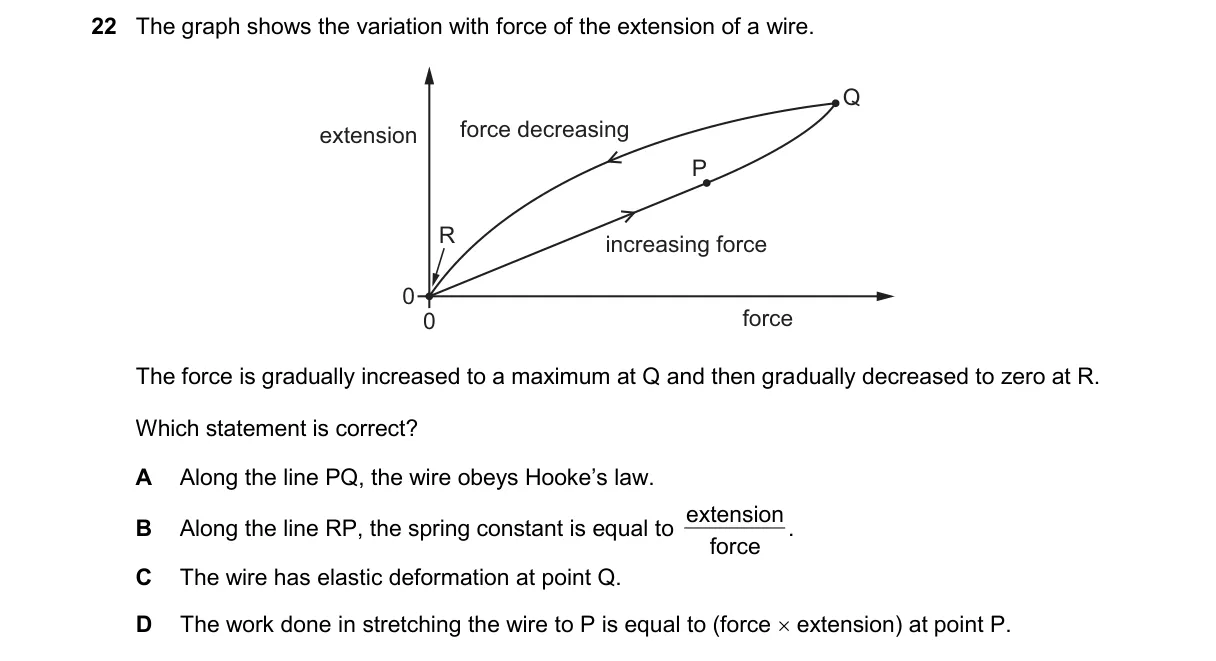
Explanation
Deformation types in wire loading-unloading cycle
Steps:
- Examine PQ: force rises linearly to maximum at Q, indicating elastic behavior if straight line.
- Examine QR: force falls to zero at R; if R extension >0, permanent set shows plastic deformation overall.
- At Q, maximum extension under load represents elastic strain component, recoverable upon unloading.
- Distinguish: total deformation at Q includes elastic part, but unloading reveals plastic hysteresis.
Why C is correct:
- Elastic deformation is reversible strain under stress; at Q, the wire's extension follows Hooke's law (stress ∝ strain), confirming elastic nature before full unloading.
Why the others are wrong:
- A: PQ may obey Hooke's law, but graph likely shows nonlinearity or yield beyond, invalidating strict obedience.
- B: PR is not the actual path (it's PQ then QR); spring constant applies only to elastic segments, not hypothetical PR.
- D: Work done is area under PQ curve, not F × extension at P (likely zero extension, so incorrect).
Final answer: C
Topic: Elastic and plastic behaviour
Practice more A Levels Physics (9702) questions on mMCQ.me