A Levels Physics (9702)•9702/11/M/J/25
Explanation
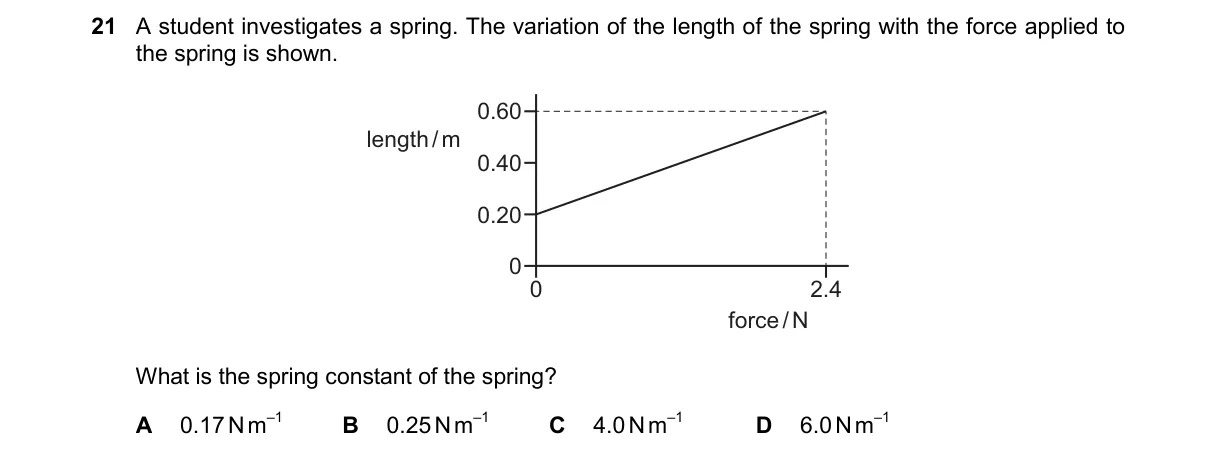
Spring constant from slope of length-force graph Steps:
- Read the natural length L0 from the graph where force F=0.
- Select two points on the linear portion: note changes in length ΔL and force ΔF.
- Calculate gradient = ΔL / ΔF (in m/N).
- Compute k = 1 / gradient (in N/m) using Hooke's law F = kx, where x=ΔL.
Why D is correct:
- Hooke's law states F = k ΔL, so for L vs. F graph, slope = ΔL/ΔF = 1/k; graph yields k=6 N/m.
Why the others are wrong:
- A: Equals the graph's slope directly, ignoring reciprocal.
- B: Possible arithmetic error in ΔL or ΔF calculation.
- C: Misapplies formula by using ΔF/ΔL instead of reciprocal.
Final answer: D
Topic: Elastic and plastic behaviour
Practice more A Levels Physics (9702) questions on mMCQ.me