Explanation
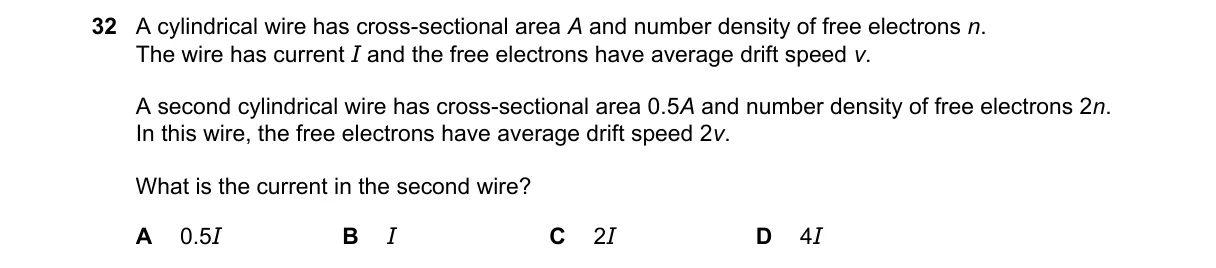
Current in a wire is I = n e A v_d Steps: - The current I equals the product of electron density n, charge e, cross-sectional area A, and drift speed v_d: I = n e A v_d. - For the first wire, this gives I = n e A v_d. - For the second wire, substitute n' = 2n, A' = 0.5A, v_d' = 2v_d to get I' = (2n) e (0.5A) (2v_d). - Simplify: I' = 2 × 0.5 × 2 × (n e A v_d) = 2I. Why C is correct: - The formula I = n e A v_d shows that doubling n and v_d while halving A multiplies the current by 2 × 0.5 × 2 = 2, yielding 2I. Why the others are wrong: - A: Halving A alone would give 0.5I, ignoring increases in n and v_d. - B: Changes do not cancel to yield I; the net factor is 2, not 1. - D: Multiplying n and v_d by 2 without halving A would give 4I, but A is halved. Final answer: …
Practice more A Levels Physics (9702) questions on mMCQ.me