A Levels Physics (9702)•9702/12/M/J/24
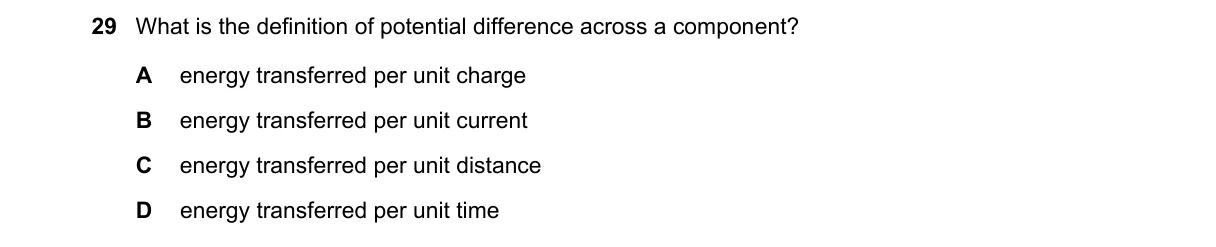
Explanation
Potential difference as work per unit charge
Steps:
- Recall that potential difference (voltage) measures the energy change for charges moving through a component.
- Identify the standard definition: it equals the work done (energy transferred) divided by the charge.
- Match this to the options: energy per unit charge directly fits the formula V = W/Q.
- Eliminate mismatches by checking units and concepts for other choices.
Why A is correct:
- Potential difference is defined as the energy transferred per unit charge, given by the formula V = W/Q, where V is voltage, W is work done, and Q is charge.
Why the others are wrong:
- B confuses it with resistance (V = IR relates voltage to current, not energy per current).
- C misapplies it to electric field strength (energy per charge per distance).
- D describes power (energy per time), not voltage.
Final answer: A
Topic: Potential difference and power
Practice more A Levels Physics (9702) questions on mMCQ.me