A Levels Physics (9702)•9702/12/M/J/24
Explanation
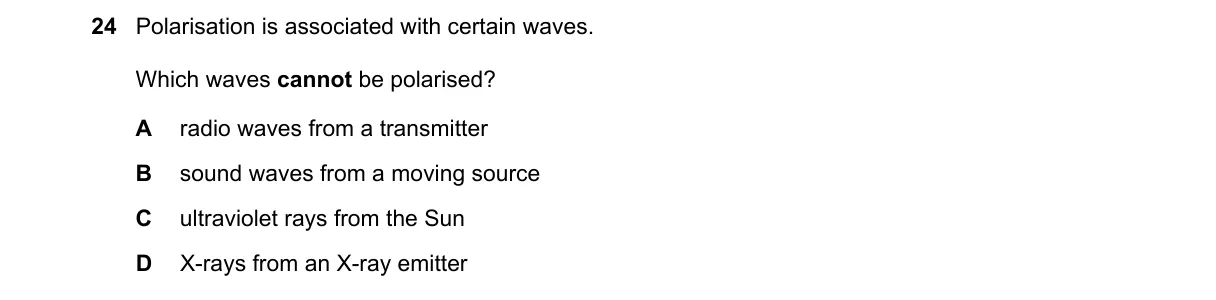
Polarization requires transverse waves Steps:
- Identify wave types: Electromagnetic waves (A, B, D) are transverse; sound waves (C) are longitudinal.
- Recall definition: Polarization involves restricting vibration direction, possible only in transverse waves.
- Apply to options: Check if each wave's nature allows polarization.
- Conclude: Longitudinal waves like sound cannot be polarized.
Why C is correct:
- Sound waves are longitudinal, with particle vibrations parallel to propagation, preventing restriction to a plane as required by polarization definition.
Why the others are wrong:
- A: Radio waves are transverse electromagnetic waves, polarizable by antennas.
- B: Ultraviolet rays are transverse electromagnetic waves, polarizable despite solar origin.
- D: X-rays are transverse electromagnetic waves, routinely polarized in experiments.
Final answer: C
Topic: Polarisation
Practice more A Levels Physics (9702) questions on mMCQ.me