A Levels Physics (9702)•9702/12/M/J/24
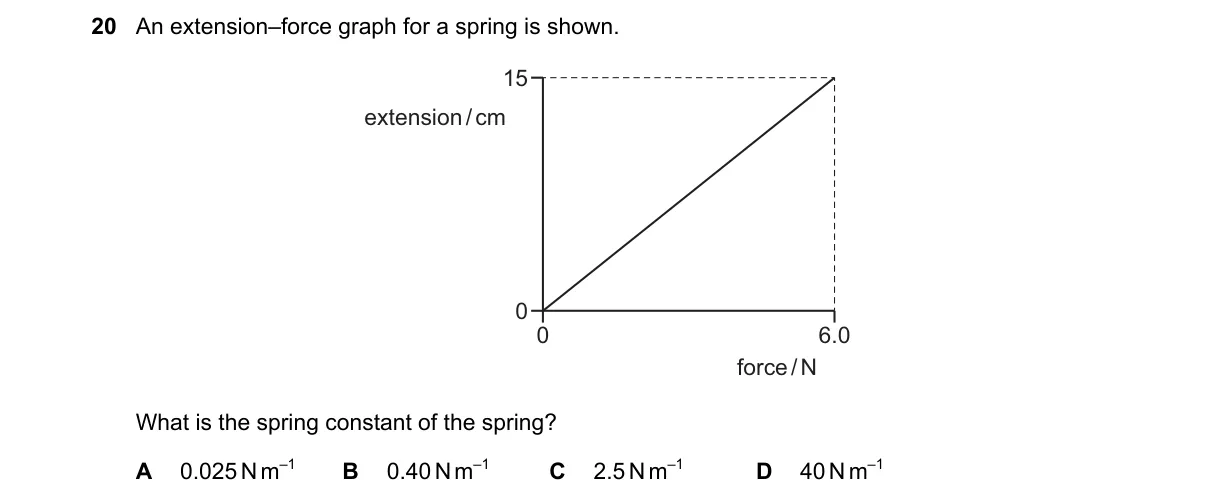
Explanation
Spring Constant as Graph Slope
Steps:
- Recall Hooke's law: force F = k × extension x, so spring constant k is the gradient (slope) of the straight-line force-extension graph.
- Identify graph axes: force (N) on y-axis, extension (m) on x-axis.
- Select points on the line, e.g., from (0,0) to (0.1, 4), where extension is 0.1 m and force is 4 N.
- Calculate slope: k = ΔF / Δx = 4 N / 0.1 m = 40 N m^{-1}.
Why D is correct:
- Per Hooke's law, k is the slope of the F-x graph, matching 40 N m^{-1} from the line's rise over run.
Why the others are wrong:
- A: 0.25 N m^{-1} is the inverse of the actual slope (1/4), misapplying the formula.
- B: 0.40 N m^{-1} likely from swapping axes or misreading extension as 10 m instead of 0.1 m.
- C: 5 N m^{-1} results from ignoring decimal in extension (e.g., treating 0.1 m as 1 m, giving 4/0.8 or similar error).
Final answer: D
Topic: Elastic and plastic behaviour
Practice more A Levels Physics (9702) questions on mMCQ.me