Explanation
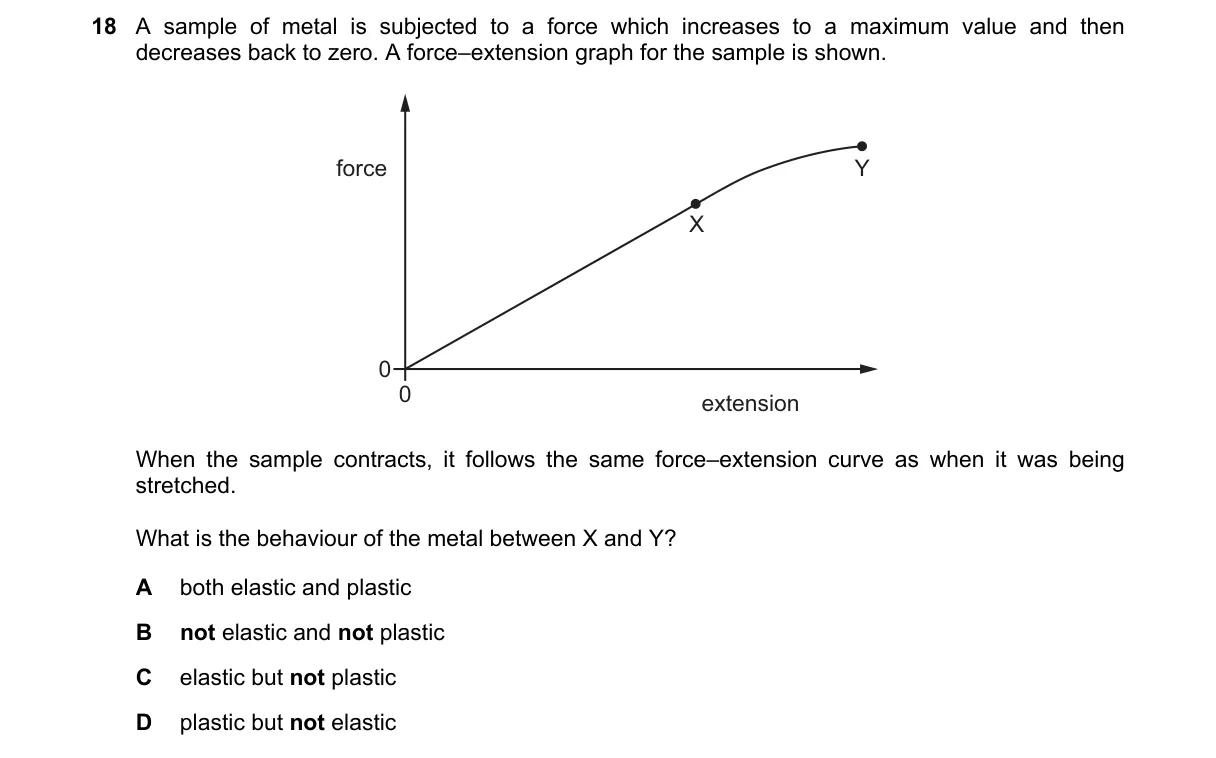
Reversible loading-unloading curve indicates elastic deformation Steps: - Elastic deformation occurs when a material returns to its original shape after force removal, with unloading following the same force-extension path as loading. - Plastic deformation involves permanent shape change, where unloading deviates from the loading path, creating hysteresis or residual strain. - The graph shows the sample follows the identical curve during both stretching and contracting between X and Y, indicating full recovery without permanent deformation. - Therefore, the behavior is elastic, as the reversible path confirms no plastic strain. Why C is correct: - Elastic but not plastic aligns with Hooke's law, where stress is proportional to strain in the reversible region, and the coinciding curves show no energy dissipation or permanent set. Why the others are wrong: - A: Both elastic and plastic is impossible here, as coinciding curves rule out any permanent deformation typical of plastic behavior. - B: Not elastic and plastic contradicts the reversible path, which defines elastic recovery, not plastic yielding. - D: Plastic but not elastic ignores the full unloading recovery, which lacks the …
Practice more A Levels Physics (9702) questions on mMCQ.me