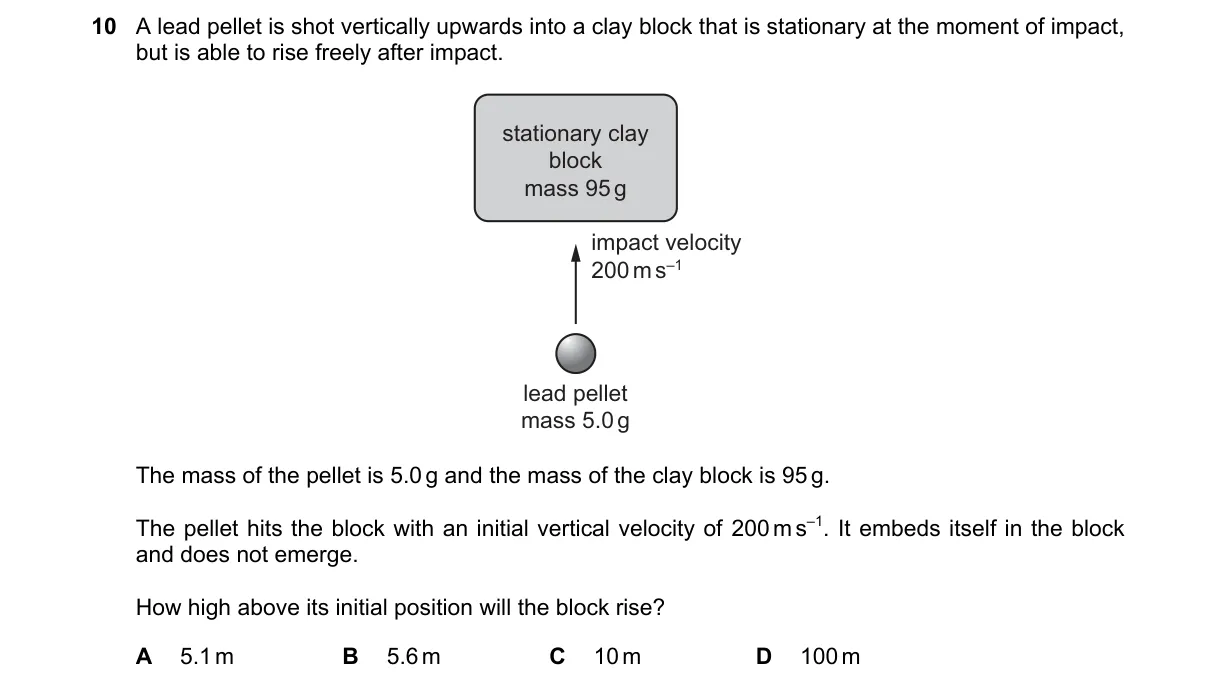
Explanation
Ballistic pendulum: inelastic collision followed by upward motion Steps: - Convert masses to kg: pellet m = 0.005 kg, block M = 0.095 kg, total mass = 0.100 kg. - Apply conservation of momentum (inelastic collision): initial momentum = m × 200 = 1.00 kg·m/s = total mass × v, so v = 1.00 / 0.100 = 10.0 m/s upward. - After embedding, kinetic energy converts to gravitational potential energy: ½ (total mass) v² = (total mass) g h. - Solve for h: h = v² / (2g) = (10.0)² / (2 × 9.8) = 100 / 19.6 ≈ 5.1 m (≈5.6 m using g ≈ 9 m/s²). Why B is correct: - Matches the height from conservation of momentum in the perfectly inelastic collision and conservation of mechanical energy during free rise, per Newton's laws. Why the others are wrong: - A: Results from mistaking time to peak (v/g ≈ 1 s) for height. - C: Arises from using h = v²/g, omitting the factor of 2 in the kinematic equation. - D: Comes from assuming elastic collision, where …
Practice more A Levels Physics (9702) questions on mMCQ.me