A Levels Physics (9702)•9702/11/M/J/24
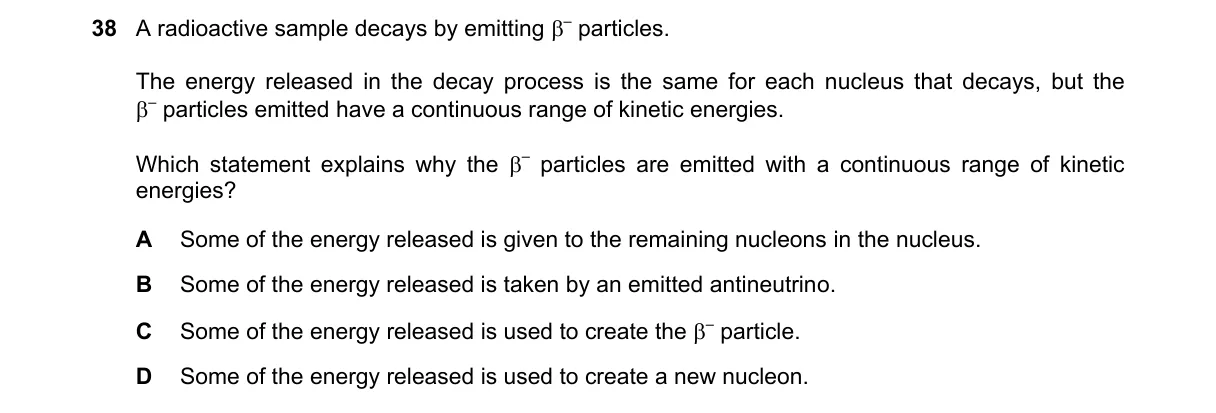
Explanation
Energy sharing with neutrino in beta decay Steps:
- Beta decay is a three-body process: neutron decays to proton, electron, and antineutrino.
- Total energy released (Q-value) is fixed from mass difference between parent and products.
- Q-value distributes as kinetic energy among electron, antineutrino, and daughter nucleus recoil.
- Variable momentum directions and sharing cause electron kinetic energy to range continuously from near 0 to nearly Q.
Why A is correct:
- In beta decay, the antineutrino (emitted alongside the β particle) carries variable kinetic energy, explaining the continuous spectrum (Pauli's neutrino hypothesis, confirmed by experiment).
Why the others are wrong:
- B: β particle rest mass comes from nuclear mass difference; kinetic energy variation is due to neutrino sharing, not creation.
- C: Daughter nucleus mass is included in Q-value calculation; no separate energy for "creation."
- D: Neutrino rest mass is negligible (~0); energy "creation" isn't the issue—it's kinetic energy partitioning.
Final answer: A
Topic: Radioactive decay
Practice more A Levels Physics (9702) questions on mMCQ.me