A Levels Physics (9702)•9702/11/M/J/24
Explanation
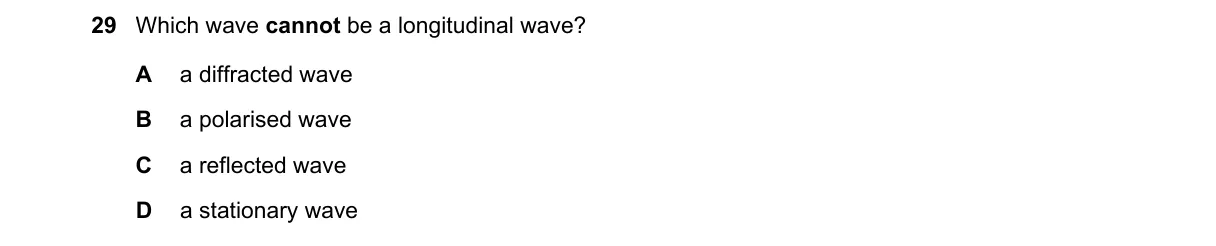
Polarization requires transverse waves
Steps:
- Longitudinal waves oscillate parallel to their propagation direction, like sound waves.
- Transverse waves oscillate perpendicular to propagation, allowing directional restriction.
- Polarization confines oscillation to a specific plane or direction, possible only in transverse waves.
- Thus, longitudinal waves lack the perpendicular component needed for polarization.
Why B is correct:
- Polarization is defined as the orientation of transverse oscillations; longitudinal waves have no such perpendicular displacement to polarize.
Why the others are wrong:
- A: Diffraction occurs in longitudinal waves, such as sound bending around obstacles.
- C: Reflection applies to longitudinal waves, like sound echoes off surfaces.
- D: Stationary waves form in longitudinal media, such as standing sound waves in pipes.
Final answer: B
Topic: Polarisation
Practice more A Levels Physics (9702) questions on mMCQ.me