A Levels Physics (9702)•9702/12/M/J/23
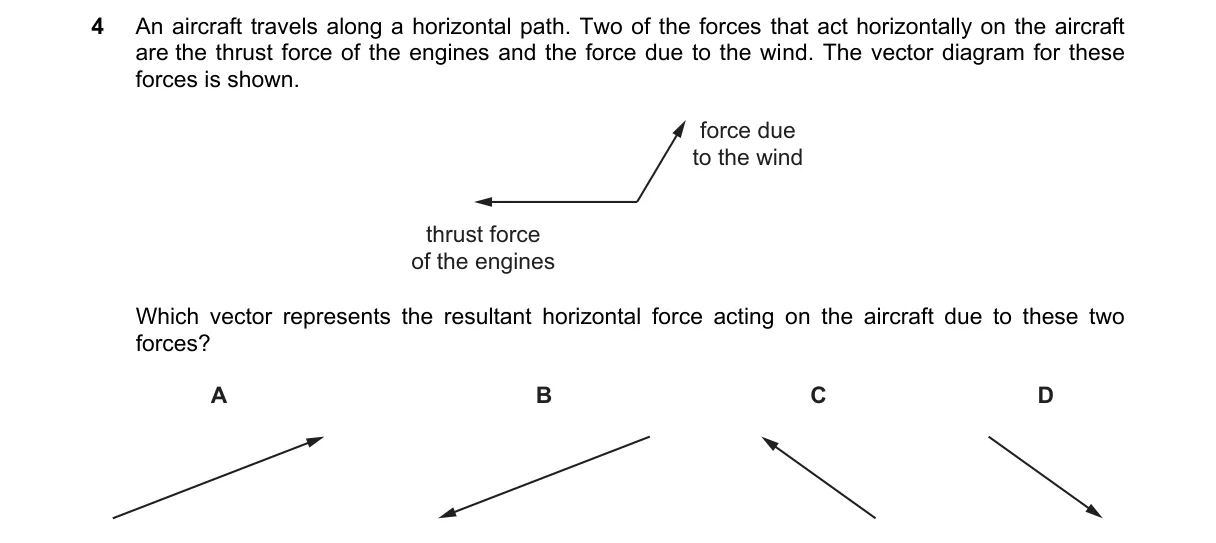
Explanation
Resultant Force from Vector Addition
Steps:
- Draw thrust and wind vectors tail-to-tail to form a parallelogram.
- The resultant is the diagonal from the common tail to the opposite corner.
- In the triangle method, place wind vector head-to-tail with thrust; resultant closes the triangle.
- Match the diagram's closing vector to option C.
Why C is correct:
- C represents the vector sum of thrust and wind per the parallelogram law of vector addition.
Why the others are wrong:
- A is the thrust vector alone, ignoring wind.
- B is the wind vector alone, ignoring thrust.
- D is an equilibrium vector (zero resultant), not the sum.
Final answer: C
Topic: Scalars and vectors
Practice more A Levels Physics (9702) questions on mMCQ.me