A Levels Physics (9702)•9702/12/M/J/23
Explanation
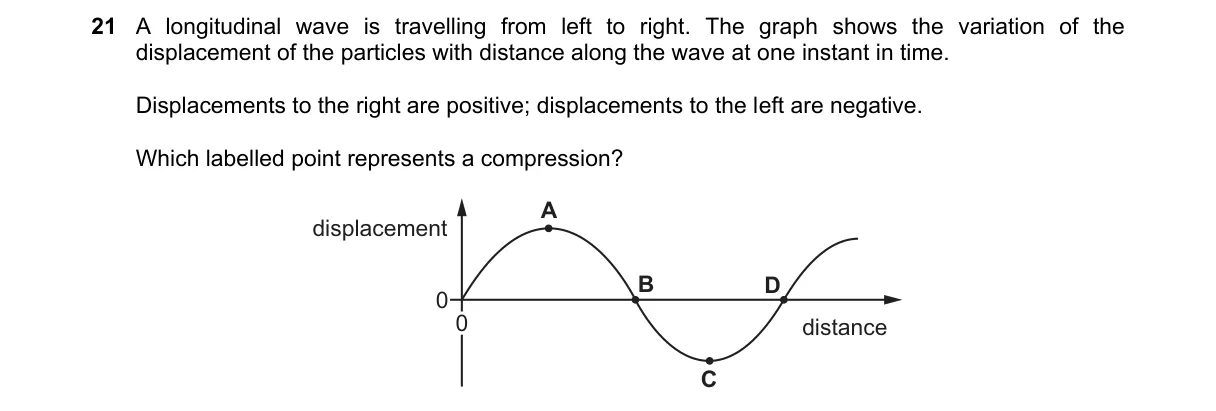
Compressions in longitudinal waves occur where the displacement-position graph has a negative slope
Steps:
- Identify the graph: displacement (vertical) vs. distance along wave (horizontal), positive rightward.
- Recall definition: compression where particles bunch up, i.e., slope du/dy < 0 (displacement decreases with position).
- Examine slopes at labelled points: A (positive slope), B (negative slope), C (zero slope), D (positive slope).
- Select point with negative slope as compression.
Why B is correct:
- At B, negative slope means particles ahead have less positive (or more negative) displacement, bunching them closer per wave mechanics.
Why the others are wrong:
- A: Positive slope indicates rarefaction (particles spread out).
- C: Zero slope indicates equilibrium (no compression or rarefaction).
- D: Positive slope indicates rarefaction (particles spread out).
Final answer: B
Topic: Transverse and longitudinal waves
Practice more A Levels Physics (9702) questions on mMCQ.me