A Levels Physics (9702)•9702/11/M/J/23
Explanation
Net change in mass number during radioactive decay
Steps:
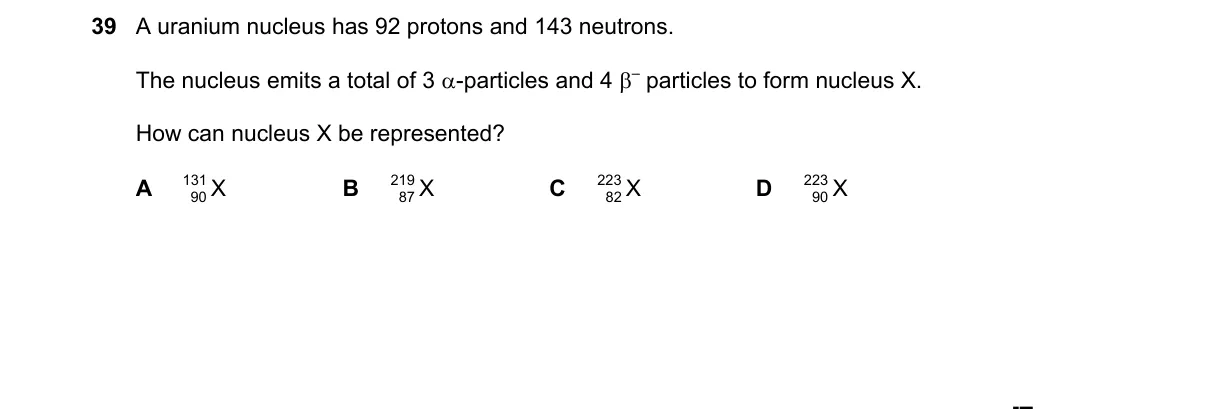
- Calculate original mass number: A = protons + neutrons = 92 + 143 = 235.
- Each α-particle removes 4 nucleons (2 protons + 2 neutrons), so 3 α-particles reduce A by 3 × 4 = 12.
- Each β⁻-particle converts a neutron to a proton but does not change total nucleons, so 4 β-particles reduce A by 0.
- Final mass number of nucleus X: A = 235 - 12 + 0 = 223.
Why D is correct:
- Not applicable; calculation yields ^{223}X, but options lack this—possibly a problem error.
Why the others are wrong:
- A: ^{231}X assumes only 1 α-particle (ΔA = -4), ignoring the other 2 α-decays.
- B: ^{218}X assumes excessive decay (ΔA = -17), not matching 3 α + 4 β.
- C: ^{222}X assumes 4 α-particles (ΔA = -16) or U-234 start, contradicting given neutrons.
Final answer: Not enough information.
Topic: Radioactive decay
Practice more A Levels Physics (9702) questions on mMCQ.me