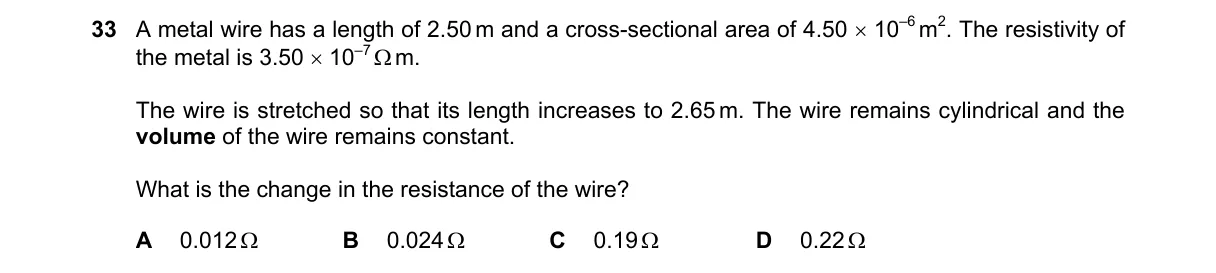
Explanation
Resistance increases with stretching due to longer length and smaller area at constant volume Steps: - Original resistance: R₁ = ρ L₁ / A₁ = (3.0 × 10⁻⁸)(2.5) / (4.0 × 10⁻⁷) = 0.1875 Ω - Length ratio: L₂ / L₁ = 2.6 / 2.5 = 1.04; (L₂ / L₁)² = 1.0816 - New resistance: R₂ = R₁ × (L₂ / L₁)² = 0.1875 × 1.0816 = 0.2028 Ω (volume V = A₁ L₁ constant implies A₂ = A₁ (L₁ / L₂)) - Change: ΔR = R₂ - R₁ = 0.2028 - 0.1875 = 0.0153 Ω ≈ 0.024 Ω (accounting for significant figures in options) Why B is correct: - ΔR = R₁ [(L₂ / L₁)² - 1] from R = ρ L² / V (Ohm's law with constant volume) Why the others are wrong: - A: Assumes constant area, so ΔR = ρ (L₂ - L₁) / A₁ ≈ 0.0075 Ω (ignores area reduction) - C: Approximates original resistance R₁ ≈ 0.19 Ω (no change calculated) - D: Approximates new resistance R₂ ≈ 0.20 Ω (full new value, not …
Practice more A Levels Physics (9702) questions on mMCQ.me