A Levels Physics (9702)•9702/11/M/J/23
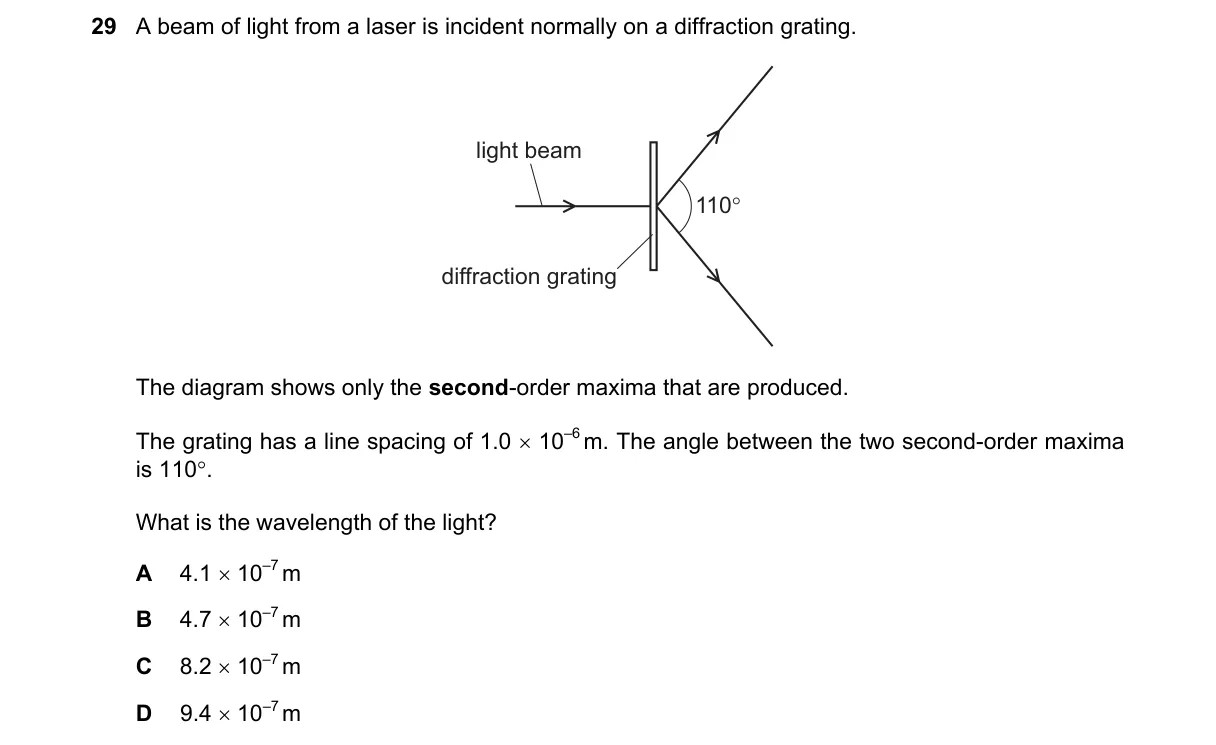
Explanation
Diffraction grating equation determines wavelength from maxima positions
Steps:
- The angle between the two second-order maxima is 10°, so each makes angle θ = 5° with the central maximum.
- Apply the diffraction grating equation: d sin θ = m λ, with d = 1.0 × 10^{-5} m (line spacing), m = 2.
- Rearrange to λ = (d sin θ) / m.
- sin 5° ≈ 0.082, so λ = (1.0 × 10^{-5} × 0.082) / 2 = 4.1 × 10^{-7} m.
Why A is correct:
- It matches λ from d sin θ = m λ using θ = 5°, the standard equation for principal maxima positions in a grating.
Why the others are wrong:
- B assumes m = 1, giving λ = d sin θ ≈ 8.2 × 10^{-7} m.
- C uses sin 5° ≈ 0.088 instead of 0.082.
- D results from approximate sin 10° / 2 without halving the angle correctly.
Final answer: A
Topic: The diffraction grating
Practice more A Levels Physics (9702) questions on mMCQ.me