A Levels Physics (9702)•9702/11/M/J/23
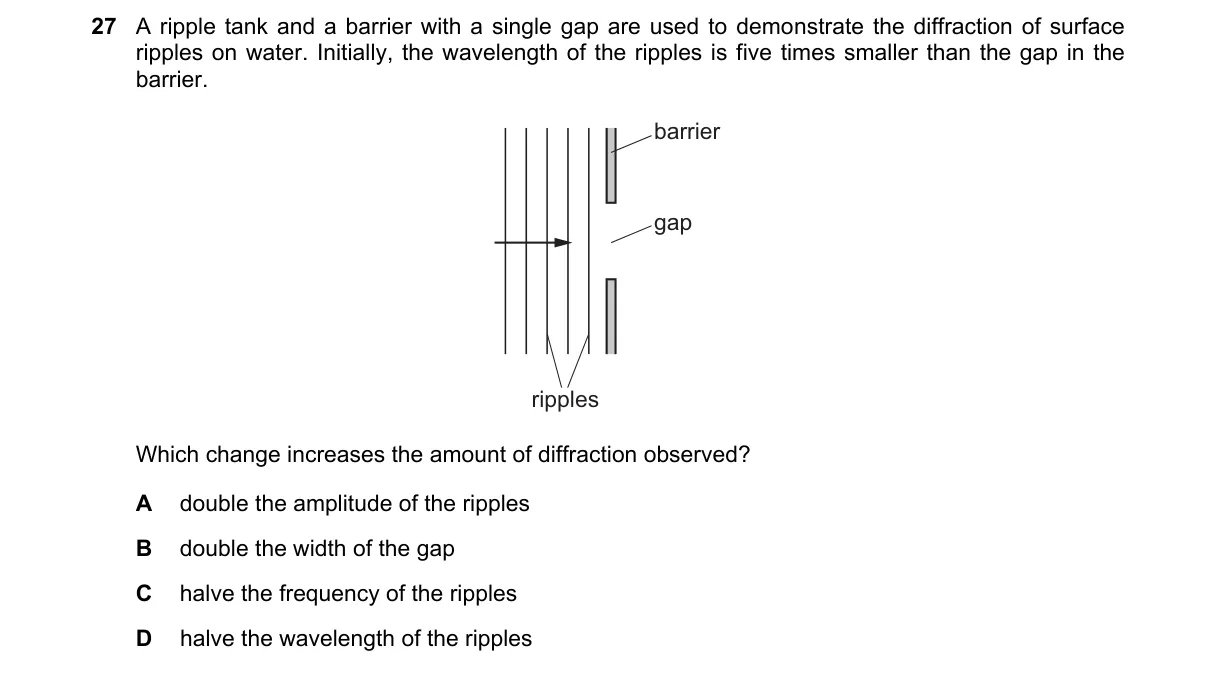
Explanation
Diffraction maximizes when wavelength nears gap width
Steps:
- Diffraction of waves is significant when wavelength λ is comparable to or larger than gap width d; initially, λ = d/5, so minimal diffraction.
- To increase diffraction, increase the λ/d ratio by enlarging λ relative to d.
- Halving frequency f doubles λ (since wave speed v = fλ is constant on water, λ = v/f).
- This changes λ/d from 1/5 to 2/5, making waves bend more around the barrier.
Why C is correct:
- Halving f doubles λ via v = fλ, raising λ/d and enhancing diffraction per Huygens' principle.
Why the others are wrong:
- A: Amplitude affects wave energy but not diffraction pattern or angle.
- B: Doubles d to 2d, halving λ/d to 1/10, reducing diffraction.
- D: Halves λ to λ/2, doubling λ/d inverse to 1/10, reducing diffraction.
Final answer: C
Topic: Diffraction
Practice more A Levels Physics (9702) questions on mMCQ.me