A Levels Physics (9702)•9702/12/M/J/22
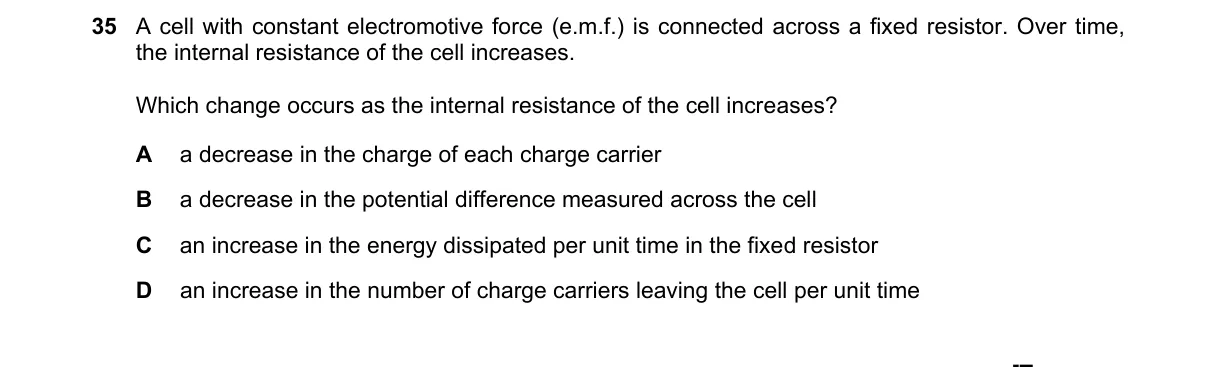
Explanation
Internal resistance rise shifts power dissipation toward the cell Steps:
- Total circuit resistance is R (fixed) + r (internal); current I = ε / (R + r), where ε is constant emf.
- As r increases, I decreases.
- Power in fixed resistor: P_R = I²R = ε²R / (R + r)², which decreases.
- Power in cell (internal): P_r = I²r = ε²r / (R + r)²; derivative shows P_r increases for r < R, typical for aging cells starting with low r.
Why C is correct:
- Energy dissipation rate in cell equals I²r; as r rises from low values, the r/(R + r)² term increases per circuit analysis, per Ohm's law and power formula P = I²r.
Why the others are wrong:
- A: Charge per carrier (electron charge e) is fixed by physics, unaffected by resistance.
- B: Potential likely means voltage or power across resistor; both I R and I²R decrease with falling I.
- D: Charge carriers per unit time equals I/e; I decreases, so number decreases.
Final answer: C
Topic: Practical circuits
Practice more A Levels Physics (9702) questions on mMCQ.me