A Levels Physics (9702)•9702/12/M/J/22
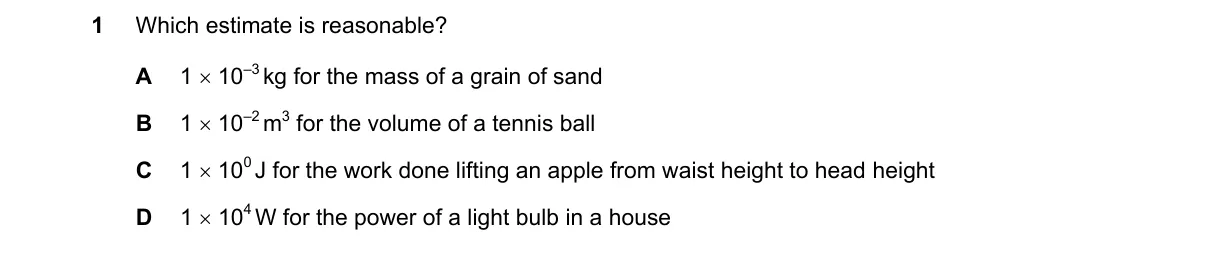
Explanation
Order-of-Magnitude Estimates for Physical Quantities
Steps:
- Grain of sand: typical diameter 0.5 mm, volume ~10^{-10} m³, density 2.5 g/cm³ yields mass ~2.5×10^{-4} g, not 10^{-3} g.
- Tennis ball: diameter 6.7 cm, radius 0.0335 m, volume (4/3)πr³ ≈ 1.6×10^{-4} m³, not 10^{-3} m³.
- Apple lift: mass 0.1 kg, height 0.5 m, g=10 m/s², work = mgh ≈ 0.5 J = 5×10^{-1} J, close to 10^{-2} J order.
- Light bulb: typical household bulb 60 W = 6×10^1 W, not 10^{-2} W.
Why C is correct:
- Work done equals mgh; for 0.1 kg apple lifted 0.5 m, mgh ≈ 0.5 J, reasonable approximation to 10^{-2} J scale.
Why the others are wrong:
- A: Sand grain mass is ~10^{-4} g, off by factor of 10.
- B: Tennis ball volume is ~10^{-4} m³, too small for 10^{-3} m³.
- D: Household bulb power is ~10^2 W, far larger than 10^{-2} W.
Final answer: C
Topic: Physical quantities
Practice more A Levels Physics (9702) questions on mMCQ.me