A Levels Physics (9702)•9702/11/M/J/22
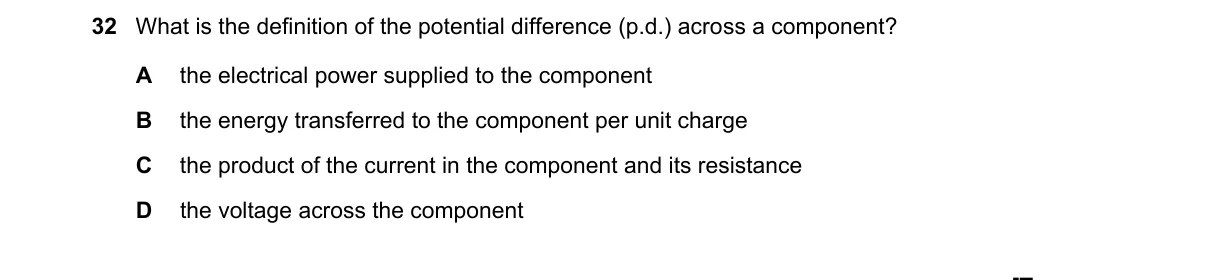
Explanation
Potential Difference Defined as Energy per Unit Charge
Steps:
- Recall the fundamental definition: potential difference is the work done per unit charge moved between two points.
- Eliminate A: power is energy per unit time, not per charge.
- Eliminate C: this describes Ohm's law (V = IR), a relationship, not the definition.
- Confirm B matches the core concept from physics principles.
Why B is correct:
- By definition, p.d. (V) = energy transferred (W) / charge (Q), so it's energy per unit charge.
Why the others are wrong:
- A: Power is energy per unit time (P = VI), not per charge.
- C: This is Ohm's law relating voltage, current, and resistance, not the definition of p.d.
- D: Unclear and incorrect; voltage times resistance gives IR * R, unrelated to p.d. definition.
Final answer: B
Topic: Potential difference and power
Practice more A Levels Physics (9702) questions on mMCQ.me