A Levels Physics (9702)•9702/11/M/J/22
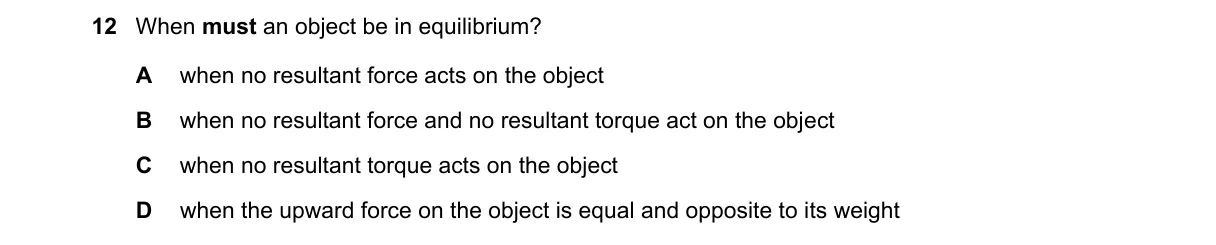
Explanation
Equilibrium in Physics
Steps:
- Define equilibrium: An object is in equilibrium if it has no linear or angular acceleration.
- For no linear acceleration, net force (resultant force) must be zero.
- For no angular acceleration, net torque (resultant torque) must be zero.
- Match options to this condition: Only zero net force and torque satisfy both.
Why A is correct:
- It directly states the conditions from Newton's first law extended to rotation: ∑F = 0 and ∑τ = 0 ensure static or constant motion equilibrium.
Why the others are wrong:
- B: Non-zero resultant force and torque cause acceleration, violating equilibrium.
- C: Zero torque alone prevents rotation but allows translation if force is non-zero.
- D: Balances vertical forces but ignores horizontal forces and torques.
Final answer: A
Topic: Equilibrium of forces
Practice more A Levels Physics (9702) questions on mMCQ.me