mMCQ.

Navigation Menu

Step into mMCQ.

Launch mMCQ. diagnostic

Explore mMCQ.

MDCAT prepFree DiagnosticPricing & SubscribeSign in

Resources

Terms & Conditions

mMCQ.

© 2021 - 2025 mMCQ.All rights reserved.

WhatsApp
A Levels Physics (9702)•9702/13/M/J/21
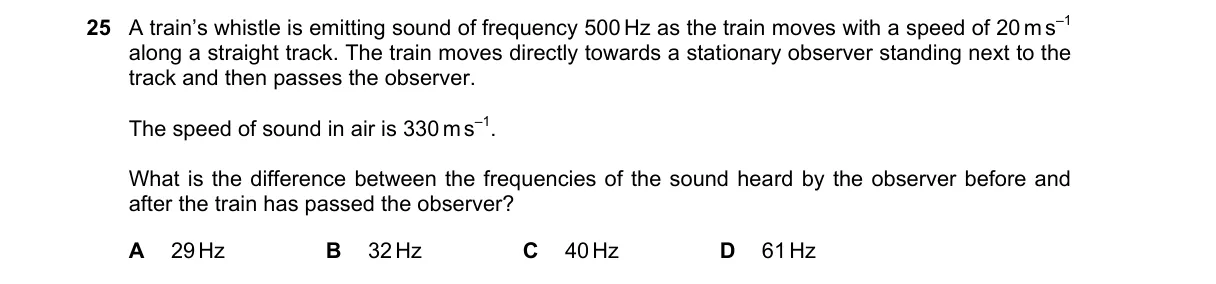
Question 25 from 9702/13/M/J/21

Explanation

Doppler Effect for Approaching and Receding Source

Steps:

  • Frequency before passing (approaching): f1=500×330330−20=500×330310≈532f_1 = 500 \times \frac{330}{330 - 20} = 500 \times \frac{330}{310} \approx 532f1​=500×330−20330​=500×310330​≈532 Hz
  • Frequency after passing (receding): f2=500×330330+20=500×330350≈471f_2 = 500 \times \frac{330}{330 + 20} = 500 \times \frac{330}{350} \approx 471f2​=500×330+20330​=500×350330​≈471 Hz
  • Difference: f1−f2≈532−471=61f_1 - f_2 \approx 532 - 471 = 61f1​−f2​≈532−471=61 Hz
  • Matches option D

Why D is correct:

  • The 61 Hz difference follows directly from the Doppler formula for a moving source and stationary observer, f′=fvv±vsf' = f \frac{v}{v \pm v_s}f′=fv±vs​v​.

Why the others are wrong:

  • A: Underestimates shift; ignores full Doppler ratio, uses rough approximation Δf≈2fvsv≈30\Delta f \approx 2f \frac{v_s}{v} \approx 30Δf≈2fvvs​​≈30 Hz.
  • B: Similar approximation error, possibly rounding vsv\frac{v_s}{v}vvs​​ incorrectly.
  • C: Arithmetically close but wrong; likely miscalculates 330/310330/310330/310 as 1.06 instead of 1.065.

Final answer: D

Topic: Doppler effect for sound waves

Practice more A Levels Physics (9702) questions on mMCQ.me