A Levels Physics (9702)•9702/13/M/J/21
Explanation
Force balance at terminal velocity including buoyancy
Steps:
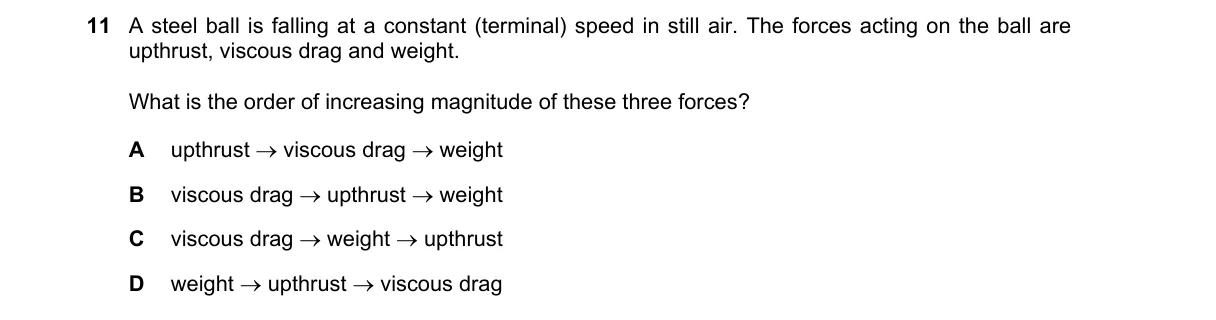
- At constant terminal speed, net force is zero: weight = viscous drag + thrust (upthrust/buoyancy).
- Weight acts downward; viscous drag and thrust act upward, opposing motion.
- For a steel ball in air, thrust (buoyant force) is negligible: thrust ≈ weight × (air density / steel density) ≈ 0.00015 × weight.
- Thus, viscous drag ≈ weight, so thrust < viscous drag < weight.
Why A is correct:
- Weight balances the sum of thrust and drag; buoyant thrust is tiny in air, making drag nearly equal to weight.
Why the others are wrong:
- B: Places viscous drag smallest, but drag dominates to balance weight.
- C: Places weight between drag and thrust, but weight is always largest.
- D: Places weight smallest, contradicting force balance where weight equals sum of others.
Final answer: A
Topic: Equilibrium of forces
Practice more A Levels Physics (9702) questions on mMCQ.me