A Levels Physics (9702)•9702/13/M/J/20
Explanation
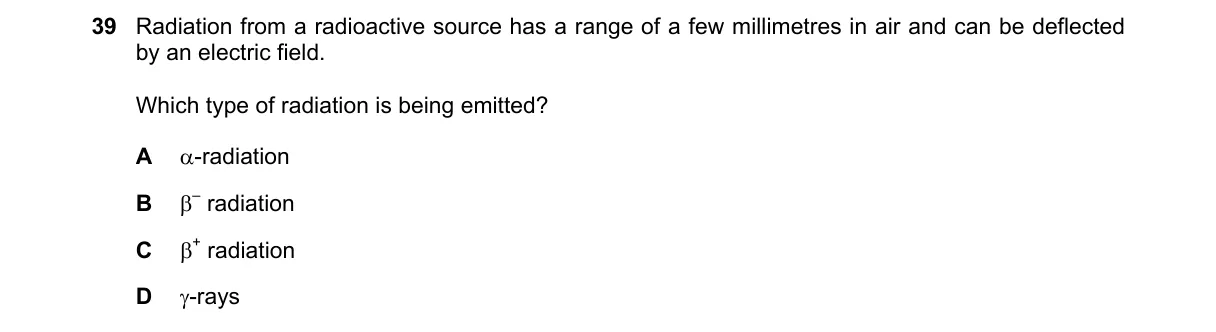
Radiation identification via range and electric deflection
Steps:
- Recall alpha radiation consists of positively charged helium nuclei with low penetration.
- Note the given range of a few millimeters in air matches alpha's limited travel distance due to high ionization.
- Observe deflection by electric field indicates charged particles; alpha's positive charge causes attraction to negative plate.
- Rule out uncharged or highly penetrating radiations that do not fit both criteria.
Why A is correct:
- Alpha particles are doubly positively charged helium nuclei, deflected toward the negative plate in an electric field per electrostatic force law (F = qE), and their high mass and charge limit range to ~few mm in air.
Why the others are wrong:
- B: Beta particles (electrons) have longer range (~meters in air) due to lower mass and charge.
- C: Gamma rays are neutral electromagnetic waves, undeflected by electric fields and penetrate far (>100 m in air).
- D: Identical to C; gamma rays lack charge for deflection and have high penetration.
Final answer: A
Topic: Radioactive decay
Practice more A Levels Physics (9702) questions on mMCQ.me