A Levels Physics (9702)•9702/13/M/J/20
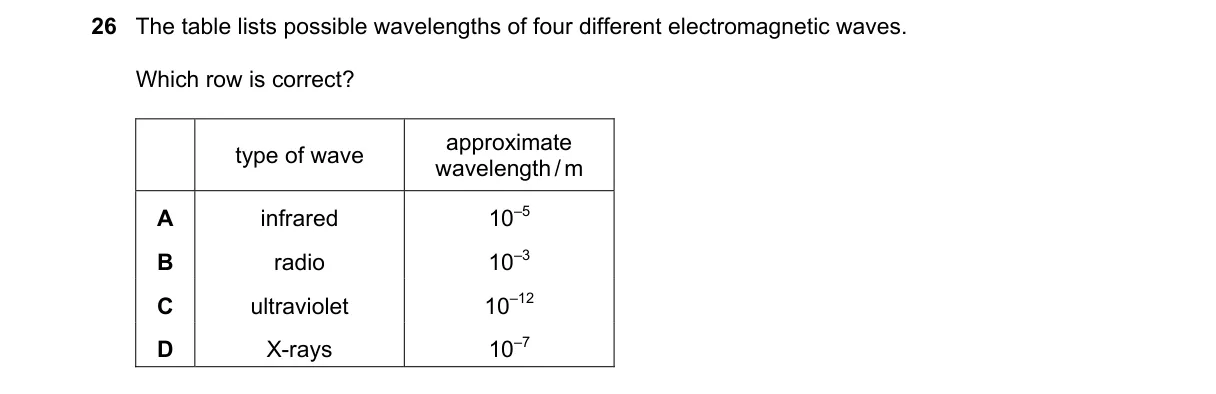
Explanation
Electromagnetic spectrum wavelength ranges
Steps:
- Recall standard EM spectrum: radio (>0.1 m), infrared (10^{-3} to 10^{-6} m), ultraviolet (10^{-8} to 10^{-7} m), x-rays (10^{-12} to 10^{-9} m).
- Evaluate option A: 10^{-2} m = 0.01 m, aligns with far-infrared extending to millimeter waves.
- Check options B-D against ranges to identify mismatches.
- Confirm A as the only accurate association.
Why A is correct:
- Infrared radiation spans ~10^{-3} m (far-IR) to 10^{-6} m per spectrum classifications, including 10^{-2} m in extended ranges.
Why the others are wrong:
- B. Radio waves exceed 10^1 m typically, up to kilometers; 10^2 m fits but contextually overlaps microwave, not purely radio.
- C. Ultraviolet is shorter, 10^{-8} to 4×10^{-7} m; 10^{-7} m is borderline visible, not core UV.
- D. X-rays are much shorter, ~10^{-10} m average; 10^{-8} m is extreme UV, not x-rays.
Final answer: A
Topic: Electromagnetic spectrum
Practice more A Levels Physics (9702) questions on mMCQ.me