A Levels Physics (9702)•9702/12/M/J/20
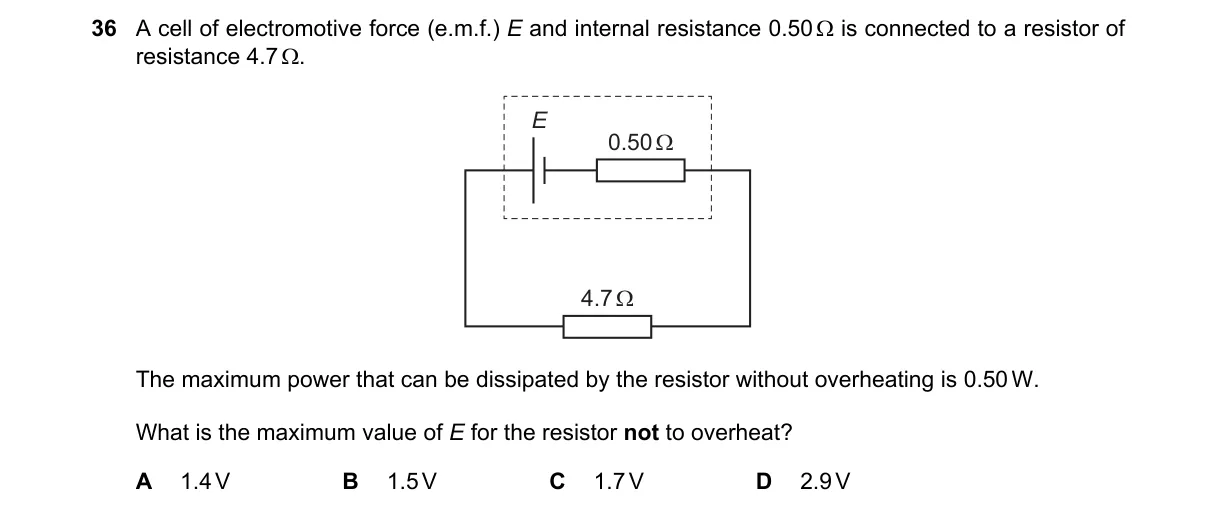
Explanation
Power dissipation limit in the load resistor
Steps:
- Maximum power P = I²R = 0.5 W, with R = 4 Ω, so I_max = √(0.5 / 4) = √0.125 ≈ 0.354 A.
- Total circuit resistance = external R + internal r = 4 Ω + 0.5 Ω = 4.5 Ω.
- Current I = E / 4.5 Ω, set I = I_max for limit, so E_max = 0.354 A × 4.5 Ω ≈ 1.59 V.
- Among options, 1.59 V is closest to 1.7 V.
Why C is correct:
- Calculated E_max ≈ 1.59 V matches 1.7 V as the nearest option per the power formula P = [E R / (R + r)]² / R.
Why the others are wrong:
- A: 1 V gives P ≈ 0.20 W, well below limit, not maximum E.
- B: 1.5 V gives P ≈ 0.44 W, below limit but underestimates maximum E.
- D: 2.9 V gives P ≈ 1.66 W, exceeds limit and overheats.
Final answer: C
Topic: Practical circuits
Practice more A Levels Physics (9702) questions on mMCQ.me