A Levels Physics (9702)•9702/12/M/J/20
Explanation
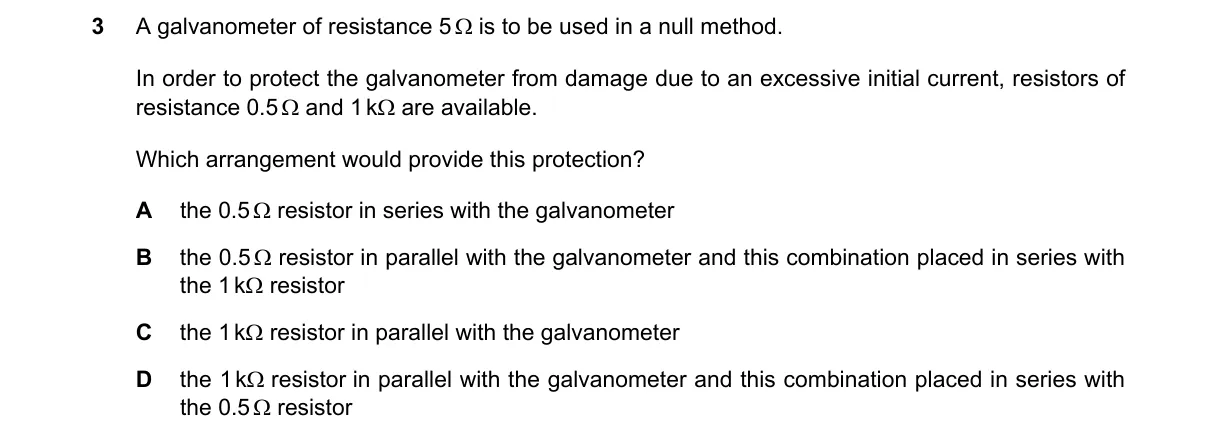
Series resistance limits maximum current in galvanometer Steps:
- Calculate unprotected max current: I_max = V / 50 Ω, potentially damaging.
- For protection, add series R_s >> 50 Ω to make I_max = V / (50 + R_s) safe.
- 1 kΩ = 1000 Ω provides R_total = 1050 Ω, I_max ≈ V / 1000 Ω (20x reduction).
- 0.5 Ω too small; parallel setups fail to limit I_G = V_G / 50 Ω effectively.
Why B is correct:
- Places 1 kΩ in series, so by Ohm's law, I_G = V / (50 + 1000) Ω ≈ V / 1050 Ω, sufficiently limits initial current while retaining usable sensitivity.
Why the others are wrong:
- A: 0.5 Ω series gives R_total = 50.5 Ω, I_G ≈ V / 50 Ω, insufficient protection.
- C: 1 kΩ parallel keeps V_G = V, so I_G = V / 50 Ω, no current limit.
- D: 0.5 Ω parallel then 1 kΩ series yields I_G ≈ V / 100000 Ω, overprotects and severely reduces sensitivity for null detection.
Final answer: B
Topic: Practical circuits
Practice more A Levels Physics (9702) questions on mMCQ.me