A Levels Physics (9702)•9702/11/M/J/20
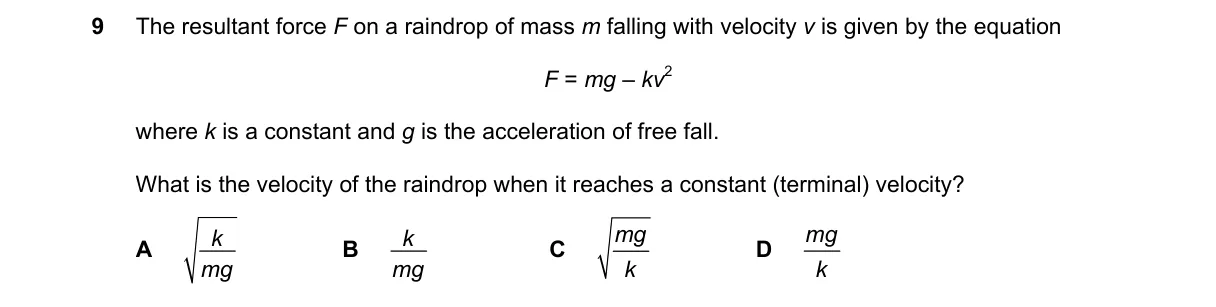
Explanation
Terminal velocity when net force is zero
Steps:
- Terminal velocity occurs when resultant force F = 0, so acceleration is zero.
- Set F = 0: mg - kv² = 0.
- Solve for v²: kv² = mg, so v² = mg/k.
- Take square root: v = √(mg/k).
Why A is correct:
- It directly matches the formula derived from balancing gravitational and drag forces at F = 0.
Why the others are wrong:
- B: Incorrectly places square root only on mg, ignoring the k in the denominator.
- C: Gives v = mg/k, which applies to linear drag (kv), not quadratic (kv²).
- D: Misapplies square root to k alone, yielding wrong dimensions.
Final answer: A
Topic: Momentum and Newton's laws of motion
Practice more A Levels Physics (9702) questions on mMCQ.me