Explanation
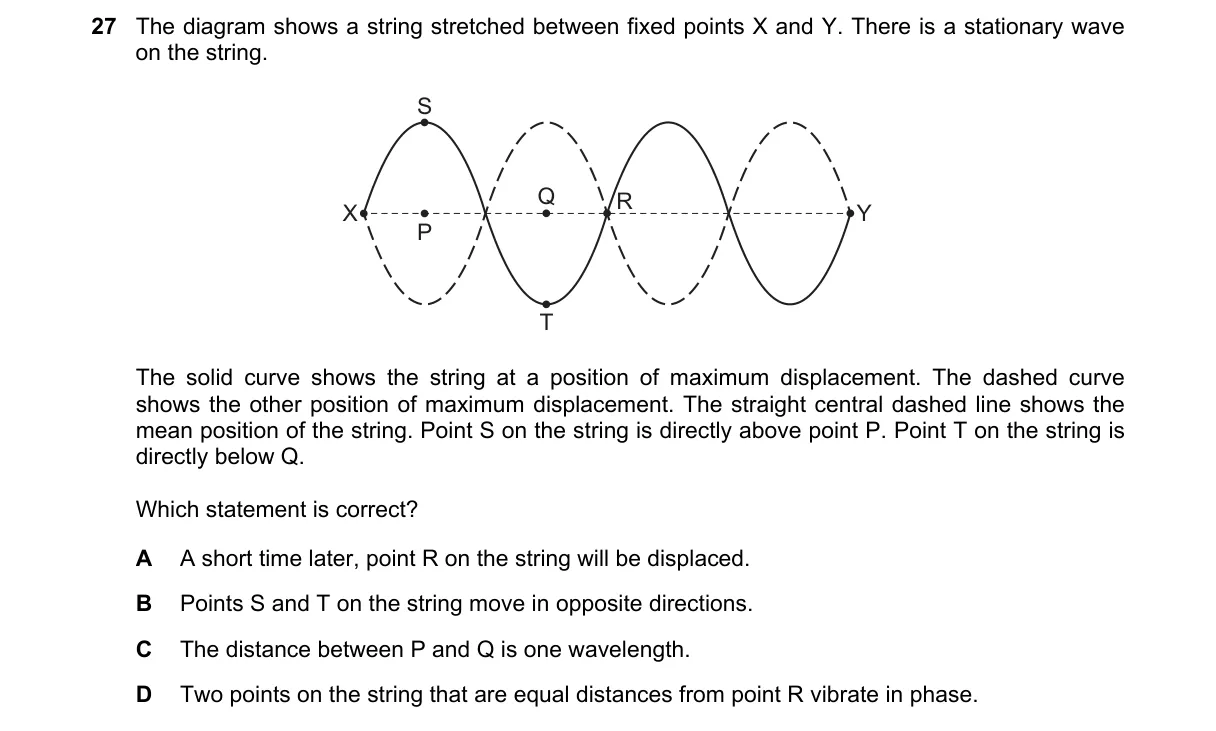
Phase Opposition in Standing Waves Steps: - Identify the solid curve as the standing wave at maximum displacement, showing antinodes at crests (like S) and troughs (like T). - Note the dashed curve as the equilibrium position, with P and Q as reference points on the mean line. - Recognize S (above P) and T (below Q) as points at opposite antinodal displacements, indicating they are likely in adjacent wave segments separated by a node. - Conclude that in a standing wave, adjacent antinodes vibrate 180° out of phase, causing opposite motion directions. Why B is correct: - In standing waves, points at adjacent antinodes (one crest, one trough) are out of phase by π radians, per the wave equation y = 2A sin(kx) cos(ωt), so they move oppositely. Why the others are wrong: - A: Without diagram details on R's location, it could be a node (stationary) or antinode (already displaced); insufficient information. - C: Points equidistant from P may be on opposite sides of a node, vibrating out of phase, not in phase. - D: P and Q …
Practice more A Levels Physics (9702) questions on mMCQ.me