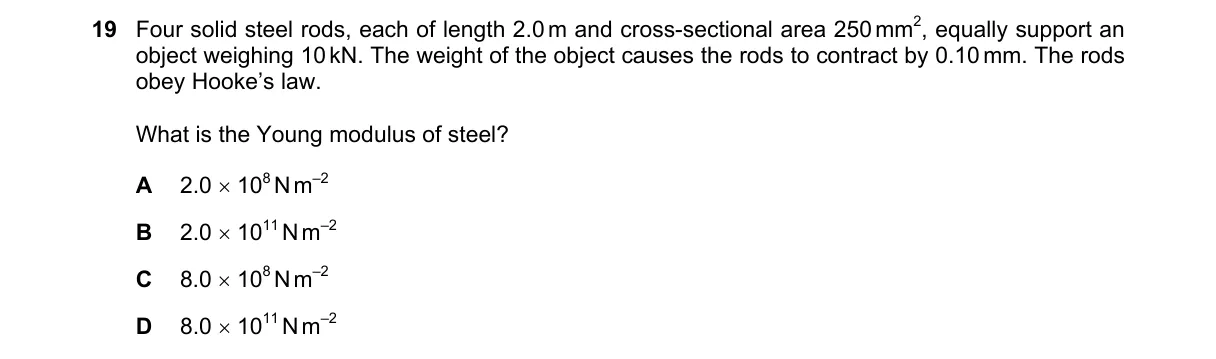
Explanation
Young's modulus calculated from stress and strain Steps: - Total load 10 kN shared equally by 4 rods, so force per rod F = 10,000 N / 4 = 2,500 N. - Cross-sectional area A = 250 mm² = 250 × 10^{-6} m² = 2.5 × 10^{-4} m²; stress σ = F / A = 2,500 / 2.5 × 10^{-4} = 10^7 N/m². - Contraction ΔL = 0.10 mm = 1.0 × 10^{-4} m; original length L = 2 m; strain ε = ΔL / L = 10^{-4} / 2 = 5 × 10^{-5}. - Young's modulus E = σ / ε = 10^7 / 5 × 10^{-5} = 2.0 × 10^{11} N/m². Why A is correct: - Matches the formula E = stress / strain, yielding standard steel value of 200 GPa. Why the others are wrong: - B: Underestimates E by factor of 10, often from mistaking mm² for cm² in area conversion. - C: Incorrect intermediate value, possibly from wrong force or strain scaling. - D: Overestimates by factor of 4, likely from using total load on …
Practice more A Levels Physics (9702) questions on mMCQ.me