A Levels Physics (9702)•9702/13/M/J/19
Explanation
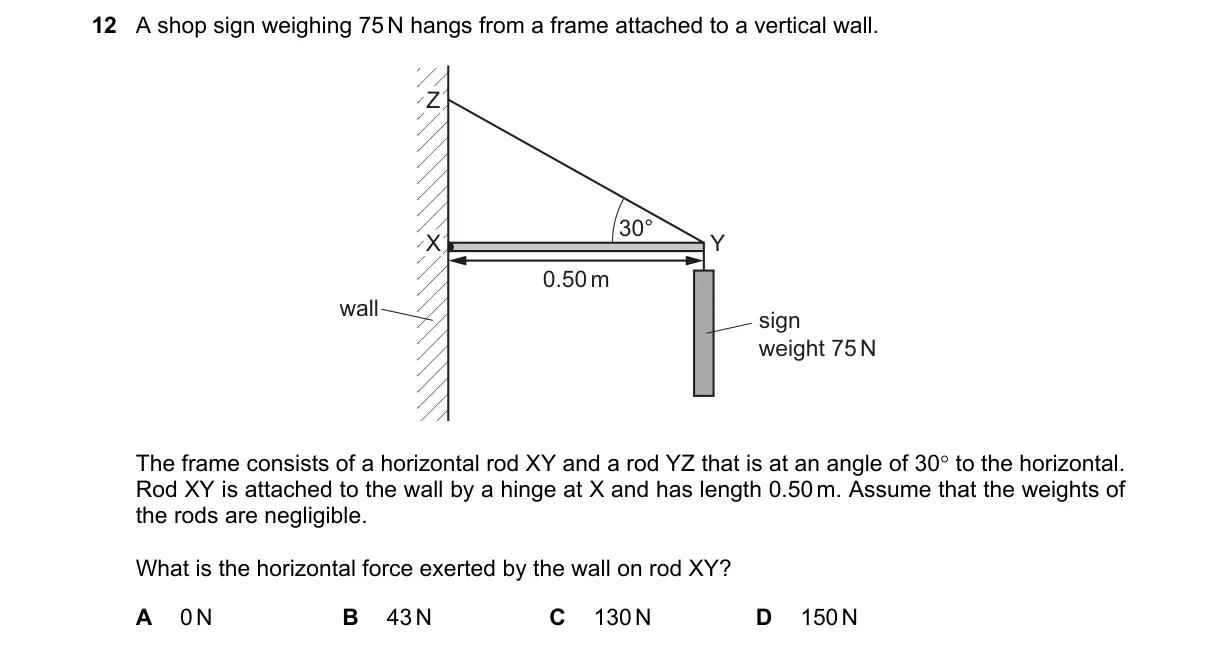
Force equilibrium at joint Y Steps:
- Weight of 75 N acts vertically downward at Y.
- Vertical equilibrium at Y requires vertical component of tension T in YZ to balance weight: T sin 30° = 75 N, so T = 150 N.
- Horizontal equilibrium at Y requires horizontal component of T to equal compressive force F in XY: F = T cos 30° = 150 × (√3/2) = 130 N.
- For massless XY, wall exerts horizontal force of 130 N on XY at X to maintain equilibrium.
Why C is correct:
- Horizontal force on XY equals horizontal component of tension in YZ, from force equilibrium along the rod's axis (Newton's third law).
Why the others are wrong:
- A: Ignores horizontal component from inclined YZ.
- B: Equals 75 tan 30° (≈43 N), confusing vertical force resolution.
- D: Tension magnitude in YZ, not horizontal component.
Final answer: C
Topic: Equilibrium of forces
Practice more A Levels Physics (9702) questions on mMCQ.me