A Levels Physics (9702)•9702/12/M/J/19
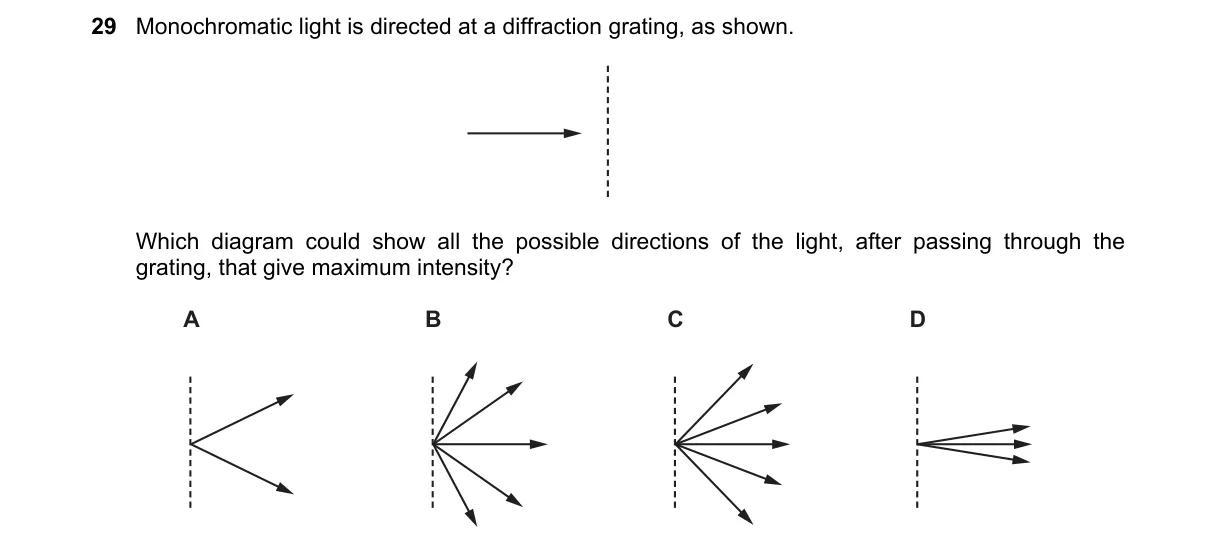
Explanation
Diffraction grating maxima follow the grating equation d sinθ = mλ
Steps:
- Monochromatic light has fixed wavelength λ, producing discrete intensity maxima.
- Grating equation d sinθ = mλ gives angles θ for integer orders m = 0, ±1, ±2, ...
- Normal incidence yields symmetric maxima: central (m=0) straight ahead, pairs at ±θ for |m| ≥ 1.
- Maximum intensity occurs only at these predicted directions, not elsewhere.
Why C is correct:
- Shows central beam (m=0) plus symmetric first- and second-order pairs on both sides, matching d sinθ = mλ for multiple orders.
Why the others are wrong:
- A: Only central maximum, omits diffracted orders required by grating equation.
- B: Asymmetric single-side beams, violates symmetry for normal incidence.
- D: Unequal spacing of beams, contradicts equal-angle pairs for integer m.
Final answer: C
Topic: The diffraction grating
Practice more A Levels Physics (9702) questions on mMCQ.me