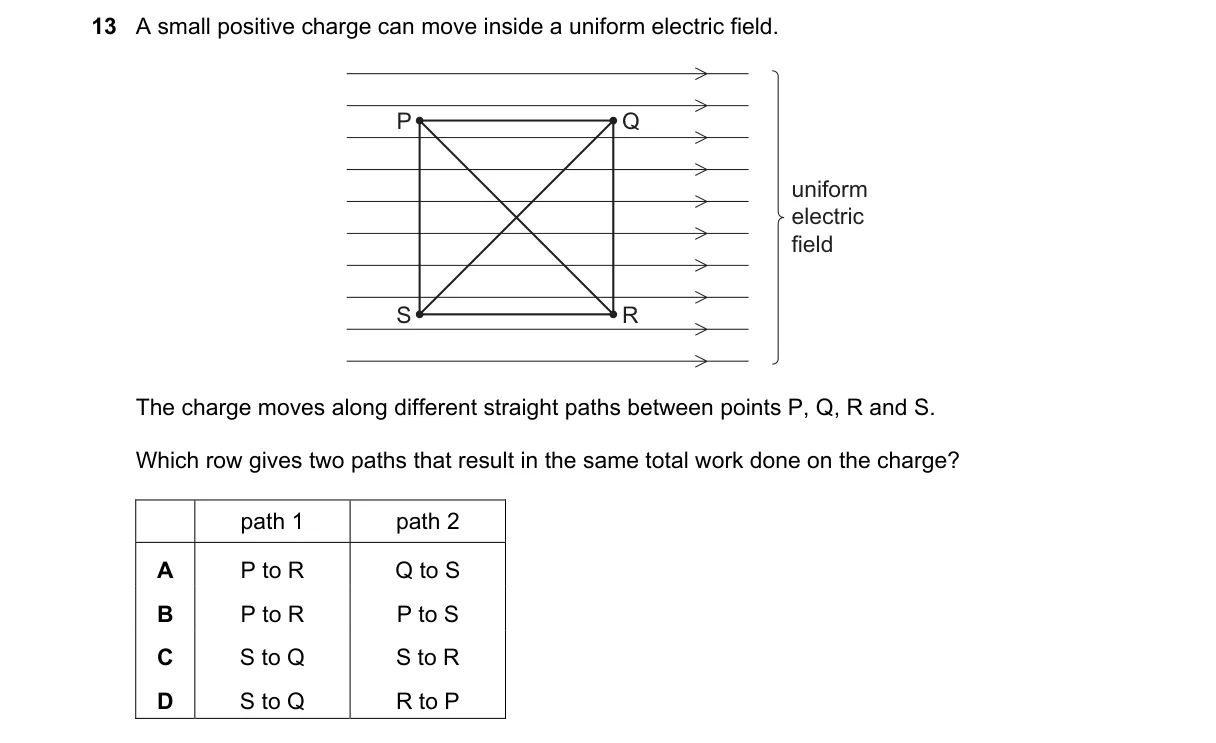
Explanation
Work by electric field depends only on potential difference between endpoints Steps: - In a uniform electric field, the work done on a charge is , where is the potential difference between start and end points. - Potential difference , so it depends only on the displacement component parallel to the field. - For paths P to S and Q to R, these connect points with the same vertical (field-direction) displacement, yielding identical . - Other path pairs have different displacements along the field, resulting in different . Why C is correct: - Paths P to S and Q to R span the same change in electric potential, as per the conservative nature of electrostatic fields (, path-independent). Why the others are wrong: - A: P to R and Q to S have unequal field-parallel displacements. - B: P to Q and R to S are likely …
Practice more A Levels Physics (9702) questions on mMCQ.me