A Levels Physics (9702)•9702/11/M/J/19
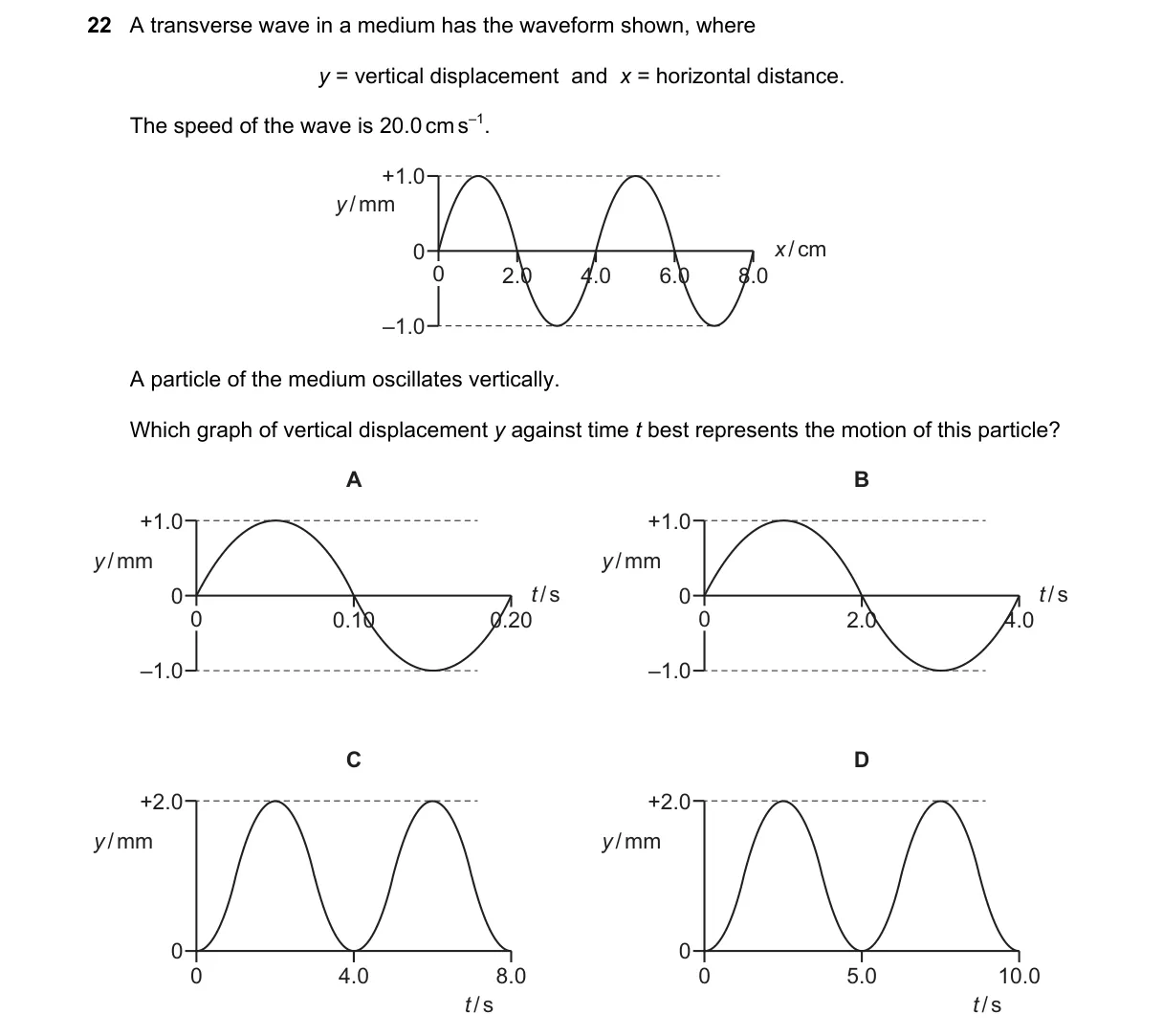
Explanation
Particle motion in transverse wave follows sinusoidal oscillation
Steps:
- Identify the waveform as a snapshot of y vs x at fixed time, showing the wave shape.
- For a particle at fixed x, its y varies sinusoidally with time t, matching the wave's frequency and amplitude.
- Wave speed v = 20 cm/s relates wavelength λ and period T via v = λ/T, but particle motion depends only on wave frequency f = 1/T.
- Graph y vs t must show periodic simple harmonic motion without distortion.
Why A is correct:
- A depicts simple harmonic motion with constant amplitude and period matching the wave's sinusoidal profile.
Why the others are wrong:
- B shows triangular waveform, not sinusoidal like transverse waves.
- C indicates damping, but waves in ideal medium have constant amplitude.
- D has irregular period, unlike uniform wave oscillation.
Final answer: A
Topic: Progressive waves
Practice more A Levels Physics (9702) questions on mMCQ.me