A Levels Physics (9702)•9702/11/M/J/19
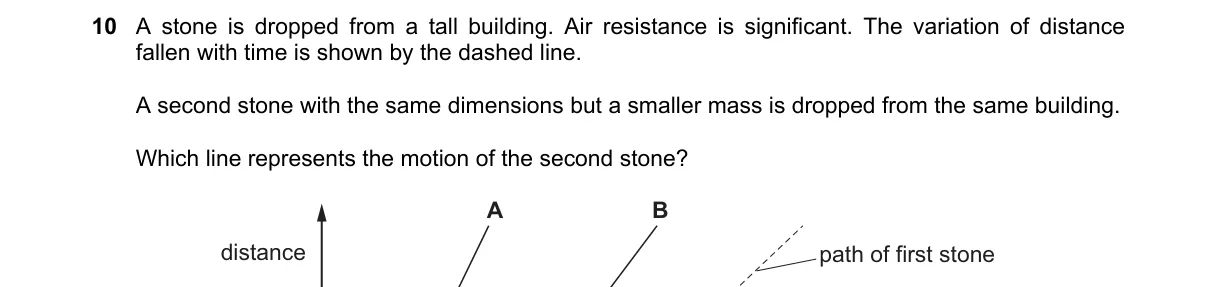
Explanation
Lighter mass leads to faster terminal velocity with air resistance
Steps:
- Air resistance force depends on cross-sectional area and speed, same for both stones due to identical dimensions.
- Gravitational force is mg; smaller mass means smaller weight, so drag-to-weight ratio is higher for the lighter stone.
- Net acceleration a = g - (drag)/m decreases faster for the lighter stone, causing quicker approach to terminal velocity (where a=0).
- Thus, distance vs. time for lighter stone curves concave-down sooner than the dashed line for the heavier stone.
Why C is correct:
- C depicts a curve bending over earlier, matching the lighter stone's faster terminal velocity per drag-to-weight ratio.
Why the others are wrong:
- A: Straight line ignores air resistance, unlike the dashed curve.
- B: Slower initial fall contradicts equal early acceleration before drag dominates.
- D: Steeper curve implies less air resistance effect, suiting heavier mass.
Final answer: C
Topic: Non-uniform motion
Practice more A Levels Physics (9702) questions on mMCQ.me