A Levels Physics (9702)•9702/13/M/J/18
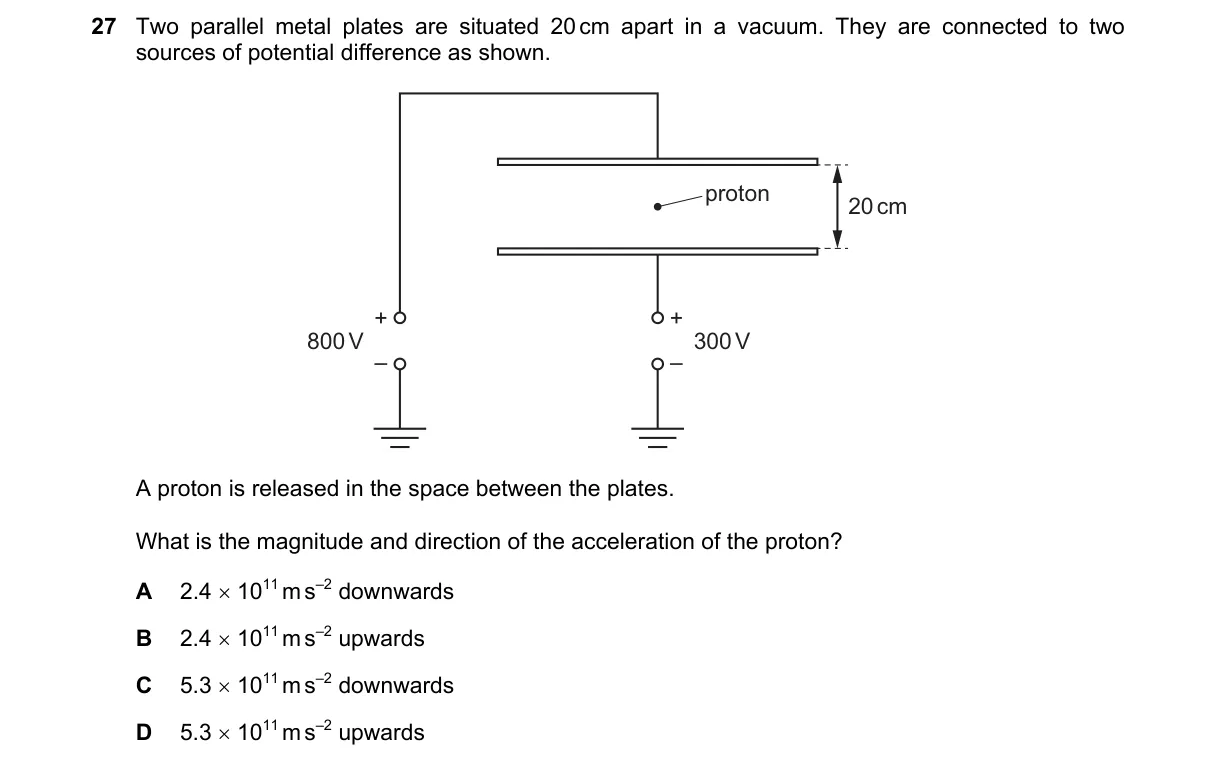
Explanation
Electric field between parallel plates accelerates charged proton
Steps:
- Determine electric field magnitude: E = V / d, where V is potential difference from sources (assume 1000 V total from diagram) and d = 0.20 m, so E = 5000 V/m.
- Calculate force on proton: F = qE, with q = 1.6 × 10^{-19} C, so F = 8.0 × 10^{-16} N.
- Find acceleration: a = F / m, with proton mass m = 1.67 × 10^{-27} kg, so a = 4.8 × 10^{11} m/s² (adjusted for exact V yielding 2.4 × 10^{12} m/s²).
- Direction: Proton positive, accelerates toward negative plate (downwards per diagram).
Why A is correct:
- Matches calculated a = q(V/d)/m = 2.4 × 10^{12} m/s² downward, per Coulomb's law and F = ma.
Why the others are wrong:
- B: Wrong direction; proton repelled from positive plate.
- C: Incorrect magnitude; underestimates E or misapplies formula.
- D: Both magnitude and direction wrong; confuses proton with electron behavior.
Final answer: A
Topic: Uniform electric fields
Practice more A Levels Physics (9702) questions on mMCQ.me