A Levels Physics (9702)•9702/12/M/J/18
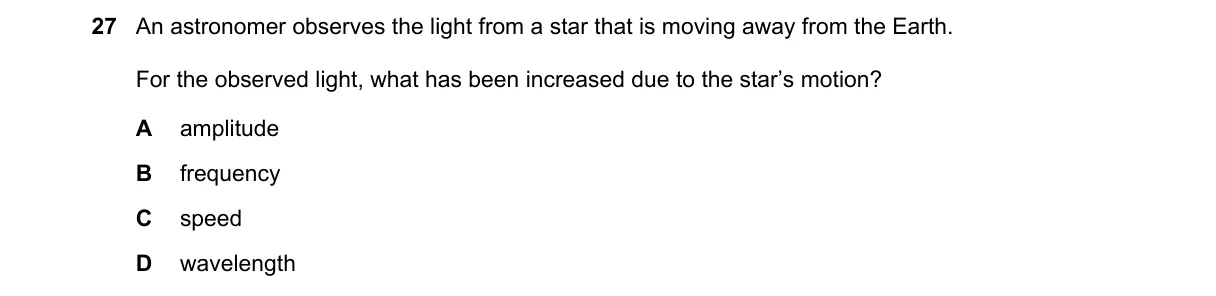
Explanation
Doppler Effect for Receding Light Source
Steps:
- Identify the phenomenon: light from a star moving away experiences the Doppler effect, causing redshift.
- Recall the effect: for a receding source, observed wavelengths stretch longer than emitted ones.
- Apply to light: the star's motion relative to Earth increases the observed wavelength.
- Conclude: no change to other properties like speed; wavelength is the key increase.
Why D is correct:
- The relativistic Doppler formula for a receding source, λ_observed = λ_emitted × √[(1 + v/c)/(1 - v/c)], shows wavelength increases (v > 0).
Why the others are wrong:
- A: Amplitude relates to light intensity, unaffected by relative motion.
- B: Frequency decreases as wavelength increases (c = fλ, constant c).
- C: Speed of light remains constant in vacuum per special relativity.
Final answer: D
Topic: Hubble's law and the Big Bang theory
Practice more A Levels Physics (9702) questions on mMCQ.me