A Levels Physics (9702)•9702/11/M/J/18
Explanation
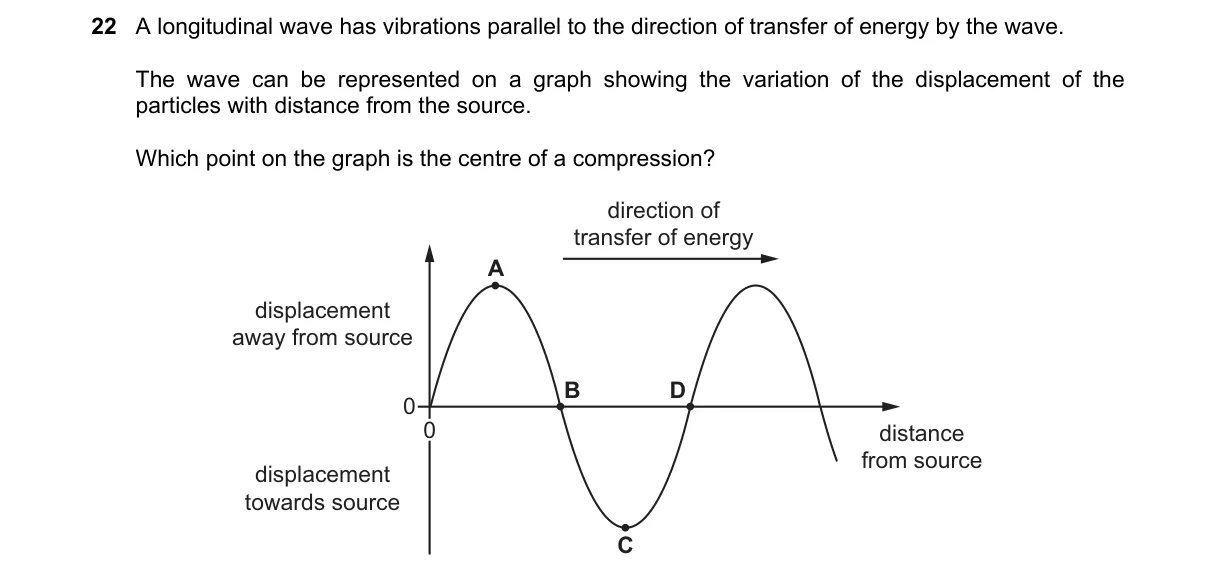
Compressions in longitudinal wave displacement graphs occur at zero-displacement points with negative slope
Steps:
- In a longitudinal wave, compressions are regions where particles are closest, corresponding to negative ∂ξ/∂x on the displacement vs. distance graph.
- ∂ξ/∂x is the slope of the graph; maximum compression is where this slope is most negative.
- For a sinusoidal wave, this occurs at points where displacement ξ = 0 and the curve crosses the axis downward (negative slope).
- Examine the graph points: select the zero-displacement point with negative slope.
Why B is correct:
- B is the zero-displacement point with negative slope, where ∂ξ/∂x is most negative, defining the compression center per wave strain definition.
Why the others are wrong:
- A: Positive displacement peak (ξ max, slope ≈0), a rarefaction center.
- C: Negative displacement trough (ξ min, slope ≈0), a rarefaction center.
- D: Zero displacement but positive slope, a rarefaction center.
Final answer: B
Topic: Transverse and longitudinal waves
Practice more A Levels Physics (9702) questions on mMCQ.me