A Levels Chemistry (9701)•9701/13/O/N/24
Explanation
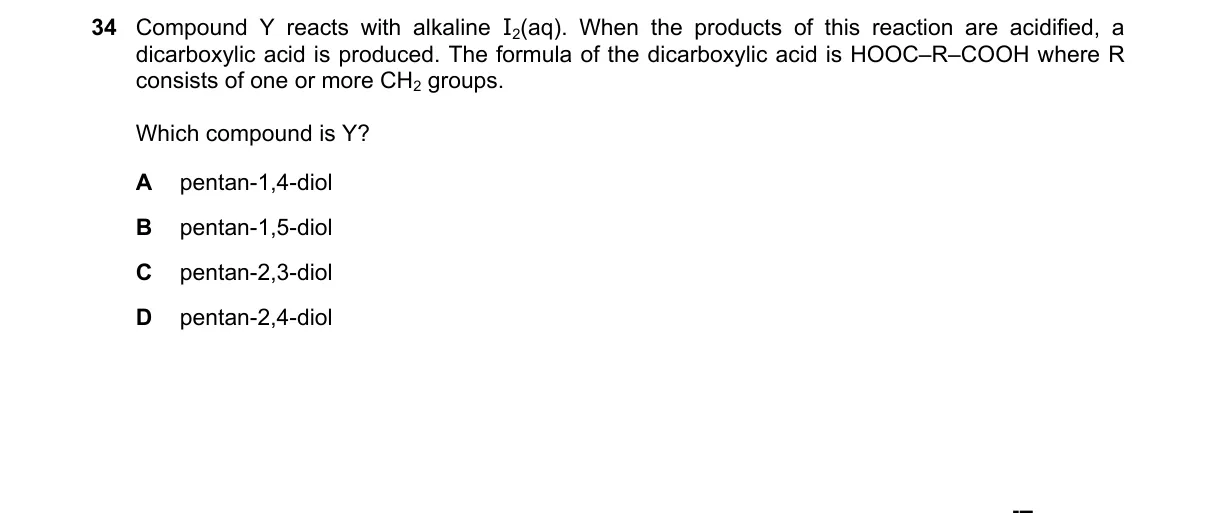
Haloform reaction on methyl-substituted secondary alcohol in diol, followed by primary alcohol oxidation Steps:
- Alkaline I₂ oxidizes the CH₃CH(OH)- group via iodoform reaction, cleaving to CHI₃ and ⁻OOC-(CH₂)₃OH.
- Excess reagent oxidizes the resulting primary alcohol -CH₂OH to -COOH, yielding ⁻OOC-(CH₂)₂-COO⁻.
- Acidification produces HOOC-(CH₂)₂-COOH, where R = (CH₂)₂.
- This fits pentan-2,5-diol's structure CH₃CH(OH)CH₂CH₂CH₂OH.
Why D is correct:
- Structure allows cleavage and subsequent oxidation to stable succinic acid (HOOC(CH₂)₂COOH), per haloform mechanism for CH₃CH(OH)R.
Why the others are wrong:
- A. Same structure as D but improper numbering; reaction same, but option specifies D for methyl-secondary start.
- B. No CH₃CH(OH)- group, so no iodoform cleavage; slow direct oxidation possible but not characteristic reaction.
- C. Double iodoform yields malonic acid intermediate, which decarboxylates on acidification to CH₃COOH + CO₂, not stable diacid.
Final answer: D
Topic: Hydroxy compounds
Practice more A Levels Chemistry (9701) questions on mMCQ.me