A Levels Chemistry (9701)•9701/13/O/N/24
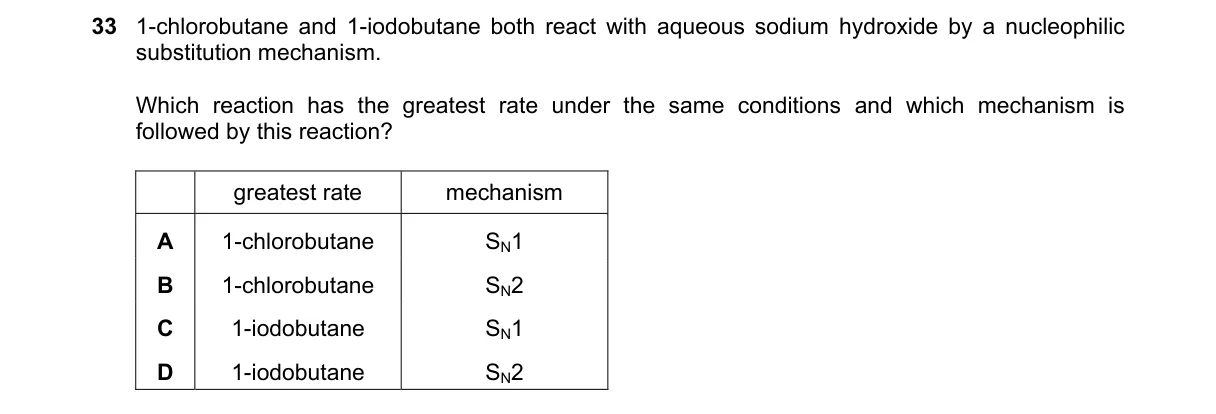
Explanation
Leaving group ability dictates SN2 rate for primary alkyl halides
Steps:
- Primary alkyl halides like 1-chlorobutane and 1-iodobutane favor SN2 with aqueous NaOH due to backside attack preference.
- SN2 rate depends on substrate and nucleophile; leaving group affects bond breaking ease.
- I- is better leaving group than Cl- as C-I bond weaker (bond dissociation energy: C-I 238 kJ/mol vs. C-Cl 351 kJ/mol).
- Thus, 1-iodobutane has greatest rate via SN2.
Why D is correct:
- 1-Iodobutane follows SN2 with fastest rate, as I- exceeds Cl- in leaving group order (I > Br > Cl > F) from polarizability and stability.
Why the others are wrong:
- A: 1-Chlorobutane follows SN2, not SN1; primary halides resist carbocation formation.
- B: Identical to D but not selected; chlorobutane slower despite same mechanism.
- C: 1-Chlorobutane SN2 correct mechanism but slower rate due to poorer Cl- leaving group.
Final answer: D
Topic: Halogen compounds
Practice more A Levels Chemistry (9701) questions on mMCQ.me