A Levels Chemistry (9701)•9701/13/O/N/24
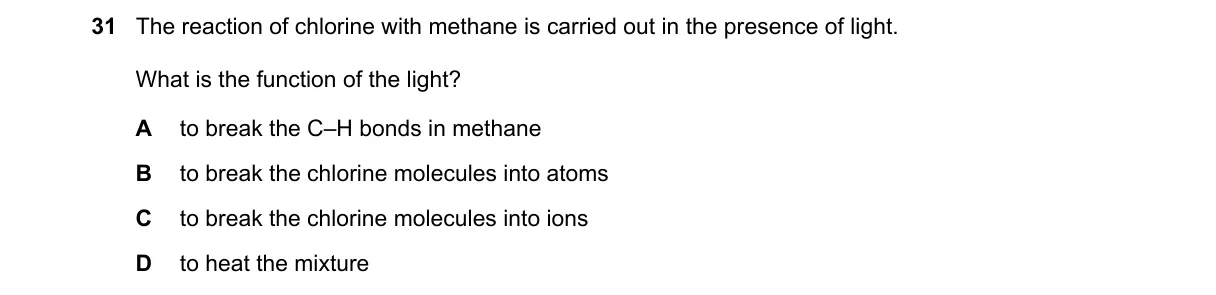
Explanation
Light initiates free radical chlorination of methane
Steps:
- Identify the reaction as free radical substitution between Cl₂ and CH₄.
- Recognize that light (UV) provides energy for the initiation step.
- Understand initiation involves homolytic cleavage of the weak Cl-Cl bond.
- Confirm chlorine atoms then propagate the chain by abstracting H from methane.
Why B is correct:
- UV light breaks the Cl-Cl bond (bond energy 242 kJ/mol) homolytically into Cl• radicals, starting the radical chain per free radical mechanism.
Why the others are wrong:
- A: C-H bonds (413 kJ/mol) are broken by Cl• radicals in propagation, not directly by light.
- C: C-Cl bonds form in the product; light doesn't break them.
- D: Light specifically excites Cl₂ for bond fission, not general heating (which would cause side reactions).
Final answer: B
Topic: Hydrocarbons
Practice more A Levels Chemistry (9701) questions on mMCQ.me