A Levels Chemistry (9701)•9701/13/O/N/24
Explanation
Oxidative cleavage of alkenes with KMnO4
Steps:
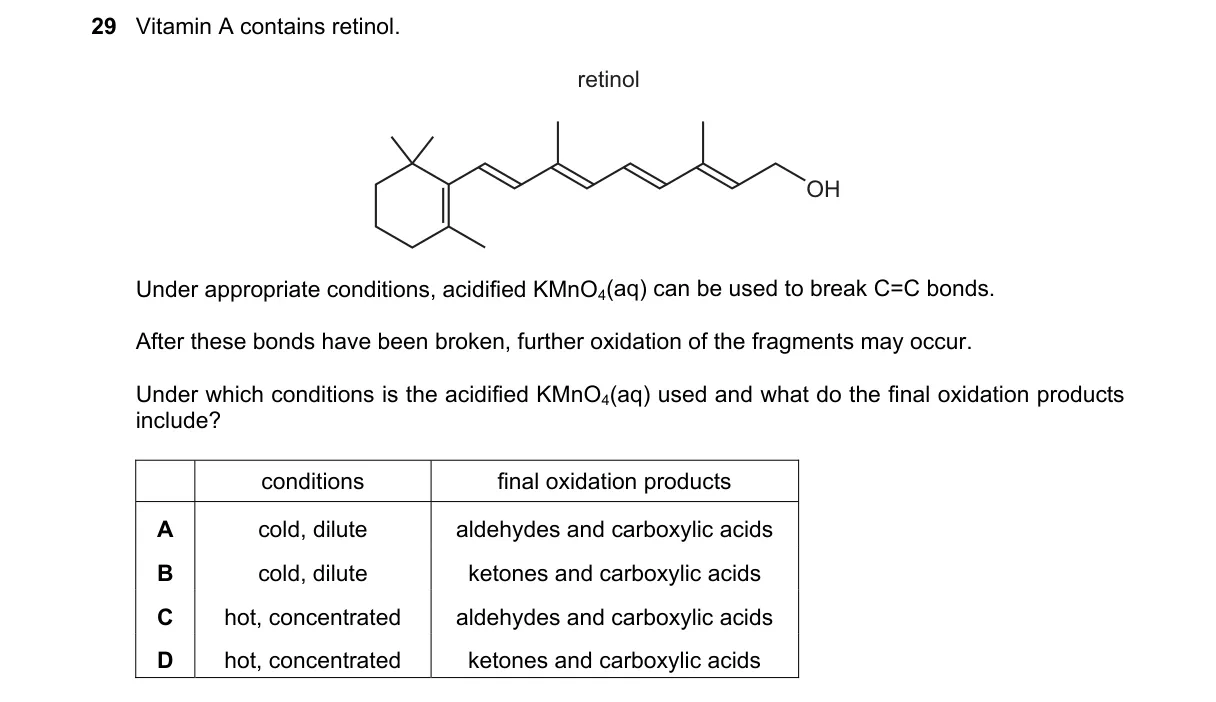
- Retinol in vitamin A has C=C bonds in a polyene chain, requiring cleavage and further oxidation.
- Acidified KMnO4 cleaves C=C under hot, concentrated conditions, unlike cold, dilute which forms diols.
- Cleavage oxidizes =CH-R to R-COOH and =CR1R2 to R1R2C=O, with aldehydes further oxidized to carboxylic acids.
- Retinol's structure yields ketone from the ionone ring and carboxylic acids from chain fragments.
Why D is correct:
- Hot, concentrated acidified KMnO4 fully cleaves alkenes and oxidizes aldehydic products to carboxylic acids, while ketonic fragments remain ketones, matching retinol's outcomes.
Why the others are wrong:
- A: Cold, dilute conditions dihydroxylate without breaking C=C bonds.
- B: Cold, dilute does not cleave to ketones or acids.
- C: Hot, concentrated oxidizes beyond aldehydes to carboxylic acids.
Final answer: D
Topic: Hydrocarbons
Practice more A Levels Chemistry (9701) questions on mMCQ.me