A Levels Chemistry (9701)•9701/12/O/N/24
Explanation
Nucleophilic addition targets electrophilic sites like carbonyl carbons
Steps:
- Define nucleophilic addition as a reaction where a nucleophile attacks an electron-deficient center, common in unsaturated or polar bonds.
- Identify functional groups: carbonyl (C=O) in aldehydes enables this due to partial positive charge on carbon.
- Evaluate options: scan for C=O presence and rule out saturated or substitution-prone structures.
- Select the compound with aldehyde functionality for nucleophilic addition.
Why B is correct:
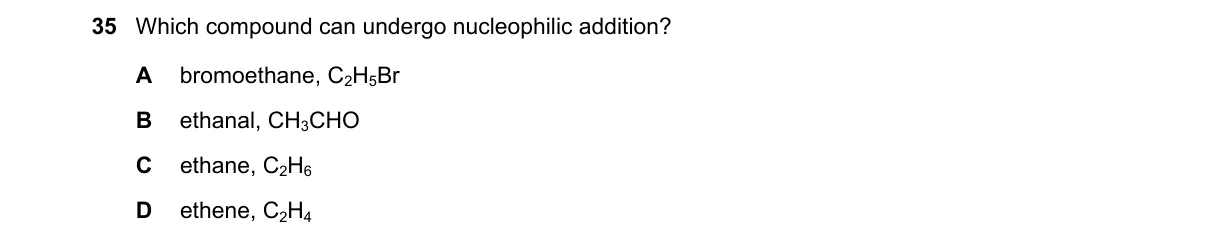
- Ethanal (CH3CHO) contains a carbonyl group where the carbon is electrophilic, allowing nucleophiles to add per the mechanism of carbonyl addition reactions.
Why the others are wrong:
- A: Bromoethane (CH3CH2Br) undergoes nucleophilic substitution at the carbon-halogen bond, not addition.
- C: Ethane (C2H6) is a nonpolar alkane with no electrophilic site for addition.
- D: Ethene (C2H4) features a C=C bond that attracts electrophilic addition, not nucleophilic.
Final answer: B
Topic: Carbonyl compounds
Practice more A Levels Chemistry (9701) questions on mMCQ.me