Explanation
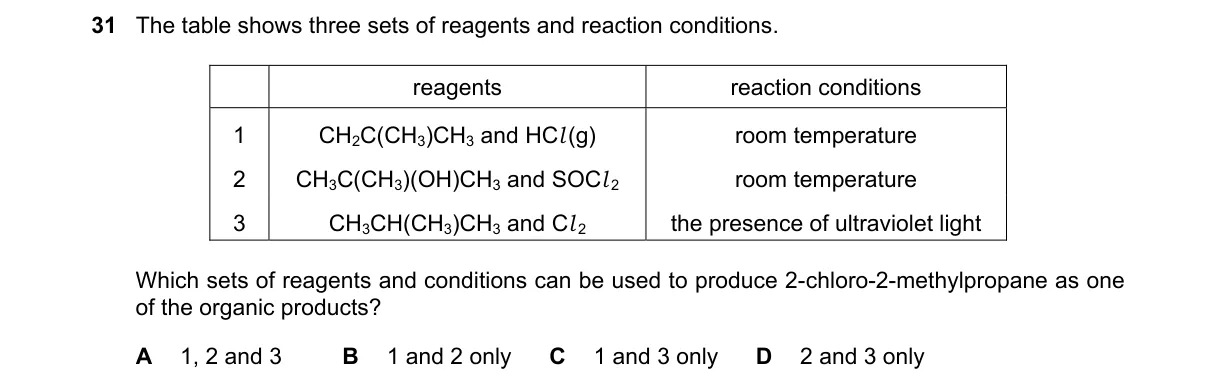
Chlorination methods for propane to yield 2-chloropropane Steps: - Recognize CH3CH2CH3 as propane, with secondary carbon at position 2; target product is 2-chloropropane (CH3CHClCH3), misnamed as 2-chloro-3-methylpropane. - Analyze set 1: HCl at room temperature enables free radical substitution if initiated, favoring secondary chloride via Markovnikov-like selectivity in radicals. - Analyze set 2: SOCl2 with HCl generates reactive chlorine species (e.g., Cl2 in situ), allowing free radical chlorination at the secondary carbon. - Analyze set 3: Cl2 under UV light promotes homolytic cleavage, leading to radical substitution primarily at the secondary carbon, yielding 2-chloropropane. Why A is correct: - All three sets facilitate free radical chlorination of propane's secondary C-H bond, as defined by the mechanism where Cl• abstracts H• to form the more stable secondary radical (stability order: tertiary > secondary > primary). Why the others are wrong: - B: Excludes sets 2 and 3, which also produce the product via chlorinating conditions. - C: Excludes set 1, which enables substitution with HCl initiation. - D: Excludes sets 1 and 2, ignoring their potential for radical chlorination. Final answer: …
Practice more A Levels Chemistry (9701) questions on mMCQ.me