A Levels Chemistry (9701)•9701/11/O/N/24
Explanation
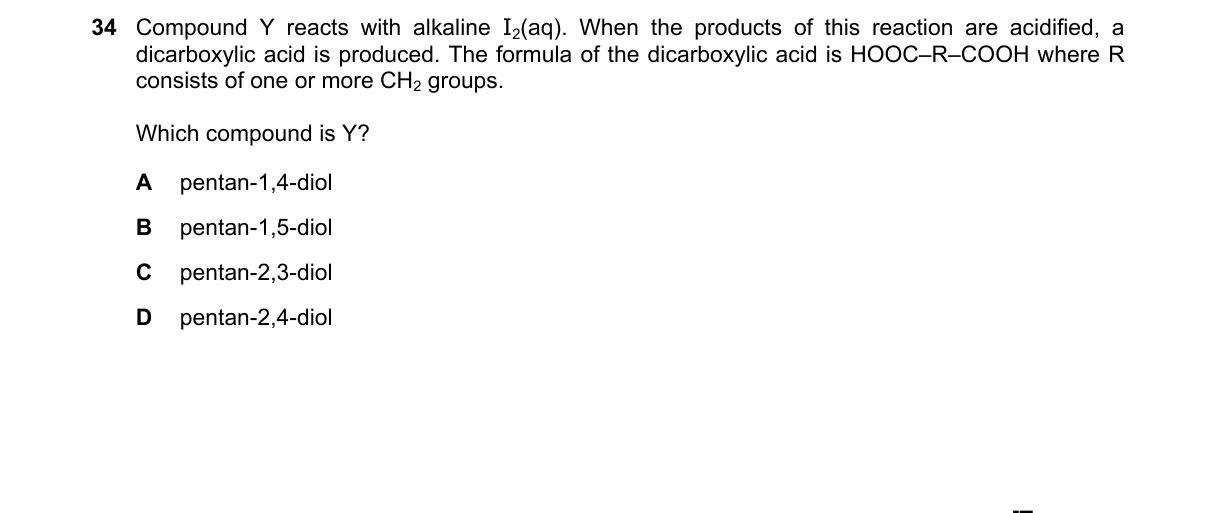
Haloform reaction on symmetric 1,3-diol yielding malonic acid Steps:
- Pentan-2,4-diol oxidizes under alkaline I₂ to 2,4-pentanedione (CH₃COCH₂COCH₃), a bis-methyl ketone.
- Each methyl ketone undergoes haloform reaction, cleaving to CHI₃ and a carboxylate.
- First cleavage yields acetoacetic acid salt (CH₃COCH₂COONa).
- Second cleavage of the remaining methyl ketone gives malonate (⁻OOCCH₂COO⁻).
- Acidification protonates to HOOC-CH₂-COOH (malonic acid), where R = CH₂.
Why C is correct:
- Pentan-2,4-diol has two CH₃CH(OH)- groups separated by CH₂, enabling double haloform cleavage to malonic acid (HOOC-CH₂-COOH) per haloform reaction mechanism.
Why the others are wrong:
- A: Primary-secondary diol; haloform at secondary end gives 4-hydroxybutanoic acid, a monocarboxylic acid.
- B: Both primary alcohols; no methyl carbinol groups, so no haloform reaction or diacid.
- D: Vicinal diol; haloform only at one CH₃CH(OH)- end, yielding 2-hydroxybutanoic acid, a monocarboxylic acid.
Final answer: C
Topic: Hydroxy compounds
Practice more A Levels Chemistry (9701) questions on mMCQ.me