A Levels Chemistry (9701)•9701/11/O/N/24
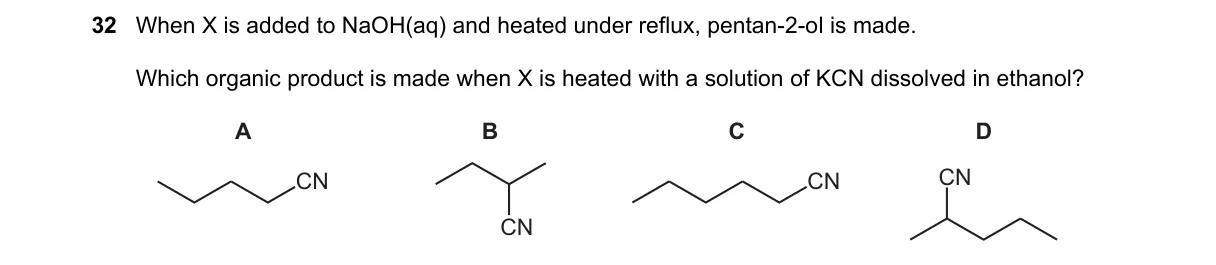
Explanation
Nucleophilic substitution with cyanide ion
Steps:
- Identify X as an alkyl halide (e.g., R-Br), which undergoes SN reaction.
- KCN in ethanol provides CN⁻ nucleophile; ethanol is polar protic solvent favoring SN1/SN2.
- Heating under reflux promotes substitution, replacing halide with CN.
- Product is alkyl nitrile (R-CN), as CN⁻ attacks carbon, displacing leaving group.
Why D is correct:
- D shows the nitrile (R-CN), formed via SN mechanism where CN⁻ bonds to alkyl chain per nucleophilic substitution definition.
Why the others are wrong:
- A is alkene from E2 elimination, requiring strong base, not CN⁻.
- B is ether from solvolysis, but CN⁻ competes and dominates.
- C is alcohol from hydrolysis, needing water, not ethanol alone.
Final answer: D
Topic: Halogen compounds
Practice more A Levels Chemistry (9701) questions on mMCQ.me